
The Rife Microscope in the Science Museum Collection
Microscope
The following report was written by Mr. Neil Brown of the
Neil Brown
Science Museum
South Kensington
London SW7 2DD, UK
Tel: +44 (0) 171 942 4168
Fax.+44 (0) 171 942 4102
internet: http://www.nmsi.ac.uk

The Rife Microscope in the Science Museum Collection
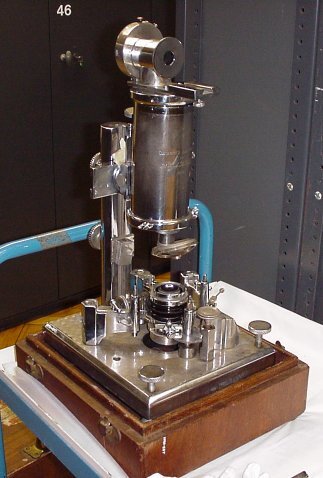
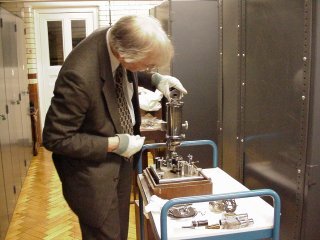
The Science Museum possesses a microscope by Royal Raymond Rife. It has the inventory number 1990-667 and was presented to the Science Museum in 1990 by the London School of Hygiene and Tropical Medicine. The School had been given it by the daughter of the late owner, Dr B W Gonin, some fourteen years previously, at a time when there was considerable interest in the Rife instruments, especially in the USA. During those fourteen years the microscope was lodged at the Wellcome Museum of Medical Science in London, where it had been reassembled, inspected and tested, and also seen by a number of people who had enquired about it.
The Science Museum received a quantity of papers with the microscope, most of them letters or personal notes made by people possibly still living. Something of the history of the microscope, and a little about Rife and others involved with it can be pieced together from the papers. There are some conflicts in the papers: The most probable version is given below and where there are serious problems this is indicated.
It seems clear the microscope was collected by Dr Gonin during a visit to San Diego in 1956, the year before his death. Dr Gonin apparently always had trouble with the instrument. Some time after the microscope was given to the London School of Hygiene and Tropical Medicine there was an allegation that Dr Gonin had not bought the instrument but had leased it for a nominal sum, and that the payments due on the lease had not been maintained. His daughter denied this strenuously. On the basis of this allegation several requests were made in about 1980 to have the microscope returned to the United States. They were refused. The microscope is No 5 of the five instruments made by Rife, and it is engraved on the barrel "designed and built by Royal R. Rife 1938". There is no explanation why a microscope apparently made in 1938 was collected by Dr Gonin in 1956. A note on the file says that "The No. 5 Rife virus microscope was built for an English doctor with quartz optics with a rotatable body similar to the Universal microscope and with an up and down movement on the fine adjustment located below the stage." There is no indication of the source of this note.
This was not the first Rife microscope that Dr Gonin had used, but the details about the previous one are not clear. The earlier microscope was brought to England by a Mr Henry Siner. When he visited England again in 1978 and saw Rife No 5 at the Wellcome Museum Mr Siner said that he had visited England in 1937, and that he had brought a "Universal" microscope. Other references to the visit suggest that it began in 1938, that the microscope was Rife No 4 (the one usually referred to as the Universal was No 3) and that Siner stayed in England until 1940, when he returned to the United States because of the war.
Rife No 4 went back to the United States. The former curator of the Wellcome Museum, who met the people who saw the microscope in the late 1970s, says in more than one place that Siner took it back, at some unspecified date, but there is no record that Siner mentioned this during his visit although he did mention bringing the microscope to Britain. Dr Gonin's daughter said that it was taken back by a Dr Yale, who stayed with Dr Gonin for that purpose, but she gives no date and as Dr Yale is mentioned nowhere else this may be an incorrect recollection. Mr John Crane, who acquired the remnants of Rife's microscopes after Rife's death in the early 1970s, also visited London in 1980 to see the instrument at the Wellcome Museum, and he said that Dr Gonin took it back in 1956 when he exchanged it for Rife No 5.
Dr Gonin's daughter also wrote on one occasion that a bigger and better Rife microscope was alleged to have been built for her father. It is impossible to be clear about what she was saying but it seems that this must have been Rife No 4, and that it had cost him "a King's ransom" - between £2000 and £4000. Dr Gonin claimed that vital parts (possibly lenses) had been withheld. On an earlier occasion the daughter stated that the microscope being built for Dr Gonin was a Universal, the implication apparently being that he never received it. It may be (and this is my speculation) that No 4 was a version of the Universal (No 3) and that possibly it was never received in complete form. What is clear, but as an inference from all the notes rather than being stated categorically, is that Dr Gonin was unable to obtain useful results with either No 4 or No 5. What he was trying to do is not explained.
In the late 1930s Dr Gonin also had some equipment from the Beam Ray which as far as I can discern was promoting a cure for cancer. There is a copy of a letter written by Gonin to Rife in October 1938 - the only document by Gonin on the file. He had just sent Rife $500 because he did "not want the microscope to be held up by any question of finance." Presumably this was before he received Rife No 4. He says also that the machines from the Beam Ray Co have just arrived and are completely useless as far as he is concerned. They were two months late, which had seriously unsettled his plans. The machines were faulty in construction, they gave out nothing but harmonics. In many cases the wires were not even attached or soldered. He had not been sent the exact frequencies and those that had been sent differed from Rife's. He felt he could not accept any money from anybody for the purpose of paying to the Beam Ray Co until the machines carried out the work for which they had been intended. He had given notice to the Beam Ray Co that he would not carry out the terms of the contract because of their serious delays. He finishes by asking whether Rife had any news about the virus of arthritis, or of measles and its frequencies.
Dr Gonin's daughter also mentions a "Ray" machine. A Mr Hodder, an uninvited visitor, came to the house with the intention of removing the machine, presumably back to the United States. When his request was refused he began to smash the machine. This was after Dr Gonin's death. The daughter says that it was an electronic cancer screening machine which her father had bought (and found utterly useless) in the years directly after the war, but I suspect she is wrong about this date and that it was just before the war. Elsewhere she describes it as a "Ray" machine which was supposed to heal "everything from warts to a world-war." There was still some of this equipment at Dr Gonin's home at the time his daughter handed over the microscope to the London School of Hygiene and Tropical Medicine. Two strange glass bulbs from this equipment survived and are also in the Science Museum.
Most of the background information about the persons involved in the Rife microscope saga comes from comments made by a Professor Hubbard when he visited the Wellcome Museum to see the microscope in 1978. Hubbard was Professor of Pathology at the State University of New York in Buffalo, and he had been interested in Rife and his microscopes since 1947. It is worth quoting extensively from the notes of his comments.
Royal Raymond Rife was born in America but went to Germany in the early 20th century, where he worked on optics and the making of lenses and microscopes for either Zeiss or Leitz. On the outbreak of World War One he returned to the United States and was believed to have been employed by the Government. He was reckoned by those who knew him to be a genius. He was a fanatical worker who could cut, grind and polish a lens in a single morning. He began building microscopes in the mid-1920s, and it seems that he built five altogether. He never sold any, but nevertheless became an extremely rich man, owning two Rolls Royce cars and a yacht. Hubbard possessed photographs of Rife 1 and Rife 2. The first was mounted horizontally on an ordinary optical bench, while the second appeared to be an upright version of the first. Hubbard was adamant that neither of these microscopes were still in existence, as they had been extensively cannibalised during the construction of later models. Rife's masterpiece was No 3, known as the Universal, built in 1933. After that he produced Rife 4 and Rife 5, which was completed in 1938. Hubbard positively identified the microscope then housed at the Wellcome Museum as Rife 5.
At some time during the 1930s Rife became a member, possibly a Board member, of the Beam Ray Company, which manufactured equipment to cure cancer. The extraordinary electrical bulbs seen at Dr Gonin's home were part of this equipment, evidently purchased by Dr Gonin. The Beam Ray Company became involved in a long, costly and protracted lawsuit, and during this time Hubbard said that Rife found it impossible to sleep. He was a non-drinker, but was advised by his doctor to take brandy as a night-cap. After building the fifth microscope he went into a slow alcoholic decline. In his heyday many academics visited Rife, but these visits began to tail off as his powers declined. [According to a note elsewhere in the file Rife died in 1974.]
Mr Siner worked closely with Rife in a technical capacity during the 1930s. He brought a Rife microscope (not Rife 5) to England in 1938, and stayed in this country for three years, returning to the United States in 1940 owing to World War Two. According to Hubbard, Siner was reckoned to be the only man alive who could assemble a Rife microscope, and the San Diego Underwater Corporation were seeking his services. This expertise of Siner was not borne out during his visit to the Wellcome Museum. On that occasion he did not demonstrate much knowledge, although he insisted that the microscope at the Wellcome Museum was not the one he brought over. [A note elsewhere records that in 1976 the Sea Equipment Advancement Corporation was interested in building an updated Rife microscope, and in 1981 someone from an American company called Oceaneering asked to borrow the microscope in London, but the request was not pursued.]
Hubbard also mentioned an Englishman called Cullen, who was living in the United States, at the age of about 86. He had given a lot of information to Hubbard about the microscopes as he had worked with Rife in the United States from about 1914 onwards. [Cullen is not mentioned anywhere else in the papers.]
John F Crane, who was still alive, worked as a mechanic with Rife from the early days of the microscopes. He became involved in the cancer cure business and was finally prosecuted for fraud with two others, and a prison sentence of three years was passed on him. According to Hubbard, Crane was almost illiterate, he had no scientific ideas and very little understanding of optics. The importance of Crane was that he possessed Rife 3 (the Universal) and also Rife 4. No-one knew how he came into the possession of these microscopes but he would not lend the Universal to anyone for an indemnity of less than a quarter of a million dollars. Crane had written a book about the microscopes which was little more that a hotch- potch of anecdote and exaggeration. Hubbard showed a copy of this book. Crane was not rich, and at the time was in poor straits.
The curator of the Wellcome Museum, who wrote the notes of the conversation with Hubbard, added comments of his own. Hubbard obviously understood optics well and was technically skilled. He had dissected Rife 5 at great speed, dictating as he did so, and paying special attention to the system of condensers which lay below the stage. His view was that the microscope was very like Rife 4 but not identical with it. Hubbard was not a very good microbiologist, and could not say what the maximum performance of Rife 5 would be. Hubbard badly wanted to obtain Rife 3 from Crane. Hubbard also believed there might be another Universal which he described as "Rife 3a".
The position with regard to all these microscopes was incredibly complex and it seemed that Crane was in a very commanding position with regard to them. He [the curator] wondered whether Rife was in some way indebted to Crane, and hence that Crane had leant on Rife very heavily after his release.
In his will Rife evidently did not mention his microscopes so that their ownership was perhaps still in dispute. Hubbard maintained that Gonin never fully paid for the microscope which Siner brought over, but Gonin's daughter maintained that Siner took away a microscope while he was in England.
Perhaps the most significant part of the story [in the opinion of the curator] was that neither here nor in the United States was there known to be a single extant microscopical preparation worked on by Rife, Gonin or anyone else. With the possible exception of one picture of a phage there is no proof that any photomicrographs were ever taken with any of the Rife microscopes.
As well as talking about giving a lot of information about Rife and those involved with him Hubbard left in London copies of some of his extensive correspondence about the Rife microscope. In a letter to Crane he stated that his objective was to obtain a satisfactory technical explanation for the phenomena which Rife observed. In the same letter he said he did not believe that Rife made a complete secret of his microscope system but that Rife gave ample opportunity to several people to examine the microscopes thoroughly. The problem was that they did not select and prepare the specimens with adequate care, and that they did not operate the instrument properly. Hubbard believed that Rife had somehow managed to combine fluorescence, polarization and interference microscopy, but he does not attempt to explain how this might have been done.
Others, of course, disagreed. One American microscope manufacturer which Hubbard contacted, Bausch and Lomb, said that they had tried to see the Rife microscope but there was so much secrecy that few people, and most of them non-microscopists, had been able to get to it. The few microscopists who had been able to see it were not well- versed in microscope theory and could, therefore, give no worthwhile opinion of its virtue. The company had never been able to get evidence to substantiate announcements that the instrument exceeded the limits of resolution which theory indicated. The Spencer Lens Company, later taken over by the American Optical company, had tested a Rife microscope, in 1936 according to Hubbard, Its performance had been no better than an ordinary instrument of similar numerical aperture, though the writer conceded that as Rife never gave a scientific explanation of his instrument it was difficult to know whether or not he accidentally ran on to some favourable conditions.
There is little in the papers about the claimed performance of the Rife microscope, but Hubbard does say something about it in a letter to a professor in Britain. Hubbard refers to about the only detailed contemporary paper about the Rife microscope, which appeared in the Journal of the Franklin Institute, vol 237, Feb 1944, pp 103-130, and also in the Annual Report of the Board of Regents of the Smithsonian Institution, 1944, pp 193-219, entitled "The New Microscopes" and written by R E Seidel and M E Winters. [The paper deals with a lot more than just the Rife microscope: the text of the two versions seems to be the same but the illustrations and references differ.] There were some photomicrographs printed with this paper, and Hubbard claimed to have seen the original negatives of these images when he had visited Crane. He reckoned they showed features about 10 nanometres in size. (Barer had already pointed out that the limit of resolution of a light microscope was reckoned to be about 200 nanometres.) Crane compared these images very favourably with electron micrographs made 20 years later, using specimen preparation techniques which had not been available at the earlier date. Barer's letter, which was an answer to a query from a journalist called Christopher Bird, was sceptical: he was not closing his mind to the possibility that Rife had come across an interesting an useful optical phenomenon but could not comment without much more information. He did point out that it was sometimes possible to detect the presence of detail smaller than the resolution limit, such as viruses, by techniques such
as phase contrast, but not to resolve those details and describe their true shape.
There are a few reference to the use of the Rife microscope by a Professor A I Kendall, the most significant being a paper called "Observations with the Rife microscope of filter-passing forms of microorganisms" written by E C Rosenow and published in Science, vol 76, 26 August 1932, pages 192-19, and a paper by Kendall and Rife in California and Western Medicine, vol 35, December 1931, pp 409-111 "Observations on Bacillus Typhosus in Its Filterable State". Both the idea of the filter-passing organisms and the high magnification claimed (8000 times) would, no doubt, have been considered controversial by others. Although there is an implication in various places in the papers now at the Science Museum that the Rife microscope was useful for studying viruses and cancer-causing organisms there is nothing clearly describing its use in this way.
Rife No 5 was tested in 1978 while it was at the Wellcome Museum, by a Professor of Physics from Imperial College in London. Practically the whole instrument was dismantled. There seemed nothing particularly remarkable about it except that it had been constructed in such a way as to make the work of microscopy tedious and cumbersome, particularly in respect of focussing the instrument. Using all the original optics it was quite impossible to obtain an image, but using a light-source, eyepiece and objective from a Reichart microscope, a very imperfect image of leukaemic blood cells was finally obtained. The image was about 30% larger than would have been expected with the use of a x6 objective and a x40 eyepiece, and this was no doubt due to the prismatic arrangement in the barrel of the microscope. The resolution, However, was extremely poor.
It was concluded that it would have been impossible to produce the known photo- micrographs with this instrument and it became clear that this explained the late Dr Gonin's complaint that he could obtain no results. One of the original photographs labelled "virus of cancer" was identified as a well-known artifact of optical systems known as "coma". It is merely a photographic rendering of an anomaly produced by defects in the optical system.
The latest document on the file, written not earlier than 1990, is a typescript account by Professor Ronald R Cowden, Emeritus Professor of Biophysics and the James H Quillen College of Medicine at East Tennessee State University. About three years prior to writing he had been contacted writing to act as a consultant on the possibility of "restoring" the Rife Universal microscope, then owned by Rife Laboratories Inc, of which Mr Barry Lynes of Mission Viejo, California, was the President. Professor Cowden saw both the Universal microscope, in August 1988, and Rife No 5 at the Wellcome Museum, in April 1990.
Mr Lynes had had to undertake legal proceedings to obtain the microscope from Crane, who had removed it from Rife's laboratory after Rife's death. After spending three years in prison for offering a bogus cancer cure, Crane had attempted to market what he claimed to be the Rife technology, and he was still living in Southern California or Arizona and offering a "super resolution" microscope for sale. Lynes was a crusading journalist and publisher who felt strongly the "Cancer Establishment" was wilfully disregarding promising approaches to the cure of cancer to safeguard their own economic well-being. Lynes had decided that Rife had had the most promising approach, and had been destroyed by the establishment. At the time Cowden saw, it the Universal microscope was in the laboratory of Dr Marcel Voegl, in the San Francisco Bay area, but it had since been moved to an institute in the Topeka, Kansas, area following a dispute between Lynes and Voegl.
The Universal microscope appeared to be a rather extensively modified American Optical research microscope of about 1932 vintage. It used a mercury-arc light source, and there was a pair of slanted round quartz prisms positioned over the light port, below the condenser. The condenser itself was a standard flint glass Abbe condenser of the period. The stage was a complex rotating circular mechanical stage, similar to the designs used on polarizing microscopes of the day. The nosepiece was centreable, indeed almost every part had some sort of minute mechanical adjustment that would allow either tilting, rotation, centring or minute movement up and down. Indeed the whole instrument was a mechanical nightmare, filled with little beautifully machined circa late-1920s or early-1930s screws, worm gears etc. The objectives were conventional flint glass objectives of American Optical and E Leitz Wetzlar (Germany) manufacture. There is no indication that these were either strain-free or contained special correction. There were no special inserts above the objectives, and the light path led directly into a prism chase inset into a tube about 30 cm long that contained the prism chase and a central element that had been vandalised out of the instrument. When this element was removed was the subject of considerable conjecture, and its contents even more. There was talk that it had been removed in the late 1940s (1948-49), and there was talk that it had been done while the instrument was in the hands of Mr Crane, who presumable sabotaged a critical element to prevent the intact instrument falling into the hands of hostile elements. We simply do not know. Cowden comments, we simply do not know. Above the prism chase was a right-angle prism and a goniometer mounting that contained a polarising prism, then at a right angle to the prism chase tube (which was between 7 and 8 cm in diameter and made of thin-walled brass) there was a standard American Optical straight binocular tube. It was not
configured as a trinocular head, and presumably it had to be reconfigured for photography. How was not clear. Some tests were conducted with the instrument. Clearly, above the prism set which was above the light source port it transmitted only in the visible range with a sharp cut-off at about 360 nanometres.
The Rife Universal microscope was quite similar in configuration to the instrument in London [Rife 5], but was larger and had more screws and knobs on it. It gave the impression of complexity for the sake of complexity, that Rife just loved making all those things. Functionally, the two were comparable. Cowden tended to agree with colleagues in the United States who pronounced it a flawed design at best.
Cowden felt that Rife was a strange man of unusual background: he had worked for a few years before World War One in a German optics firm (Zeiss or Leitz). Later he had become a mechanic and driver to a Cleveland-based ball-bearing manufacturer who appears to have funded his research. He also seems to have won over the support of at least two individuals with acceptable credentials, a microbiologist at Northwestern University in Evanston, Illinois, and a physician in the Los Angeles area. The microbiologist was interested in documenting "pleomorphism" (but in a meaning of the work different from the current one). The microbiologist and his associates were trying to disprove the Pasteur "germ theory", that a specific bug is responsible for specific diseases. Their idea was that, like matter, bacteria changed form: at one time a bacillus is seen, next a virus. The virus gets very nasty in cancer and either causes or accompanies it. The Los Angeles physician was treating cancer with the "magic black box", and this drew the ire of the American Medical Association and led to the legal cases that destroyed Rife as a player.
Cowden mentions very briefly some other who had experimented with super-resolution microscopes. He ends by asking whether this strange man, Rife, could have muddled into something far before its time in what might be called a "low-tech" manifestation. He concedes it is possible, but not very probably. He suspected that Rife microscopes would remain a historical footnote in the history of light microscopy, and offer one of the interesting mysteries of that usually tedious business. Cowden finishes by recommending the following recent books to anyone interested in Rife.
The Cancer Cure That Worked, by Barry Lynes, published by Marcus Books, Toronto, Canada, in 1987.
The Healing of Cancer, by Barry Lynes, published by Marcus Books, Queensville, Ontario, Canada, in 1989
The Galileo of the Microscope, by Christopher Bird, published by La Presses de l'Université de la Personne Inc, St Lambert, P.Q., Canada.
It is obviously possible to see links between what Cowden wrote and other information about Rife. On 10 September 1929 Rife had been issued American patent 1,727,618 for a microscope lamp, and it may be that this is the type of light source that Cowden saw on the Universal microscope. The "magic black box" for treating cancer is presumably the beam ray equipment.
C N Brown
7 April 1993
Das Rife-Mikroskop in der Sammlung des Science Museum
Das Science Museum ist im Besitz eines Mikroskops von Royal Raymond Rife. Es hat die Inventarnummer 1990-667 und wurde dem Science Museum im Jahr 1990 von der London School of Hygiene and Tropical Medicine geschenkt. Die Schule hatte es von der Tochter des verstorbenen Besitzers, Dr. B. W. Gonin, etwa vierzehn Jahre zuvor erhalten, zu einer Zeit, als vor allem in den USA ein großes Interesse an den Rife-Instrumenten bestand. Während dieser vierzehn Jahre war das Mikroskop im Wellcome Museum of Medical Science in London untergebracht, wo es wieder zusammengebaut, inspiziert und getestet wurde und auch von einer Reihe von Personen, die sich danach erkundigt hatten, gesehen wurde.
Das Science Museum erhielt mit dem Mikroskop eine Reihe von Papieren, die meisten davon Briefe oder persönliche Notizen von Personen, die möglicherweise noch leben. Aus den Papieren lässt sich etwas über die Geschichte des Mikroskops und ein wenig über Rife und andere, die damit zu tun hatten, zusammensetzen. Es gibt einige Widersprüche in den Papieren: Im Folgenden wird die wahrscheinlichste Version wiedergegeben, und wo es ernsthafte Probleme gibt, wird darauf hingewiesen.
Es scheint klar zu sein, dass das Mikroskop von Dr. Gonin während eines Besuchs in San Diego im Jahr 1956, dem Jahr vor seinem Tod, gesammelt wurde. Dr. Gonin hatte offenbar immer Probleme mit dem Instrument. Einige Zeit nach der Übergabe des Mikroskops an die London School of Hygiene and Tropical Medicine wurde behauptet, Dr. Gonin habe das Gerät nicht gekauft, sondern für einen geringen Betrag geleast, und die fälligen Leasingzahlungen seien nicht geleistet worden. Seine Tochter bestritt dies vehement. Auf der Grundlage dieser Behauptung wurden um 1980 mehrere Anträge auf Rückgabe des Mikroskops in die Vereinigten Staaten gestellt. Sie wurden abgelehnt. Das Mikroskop ist die Nr. 5 der fünf von Rife hergestellten Instrumente, und auf dem Korpus ist eingraviert "designed and built by Royal R. Rife 1938". Es gibt keine Erklärung dafür, warum ein Mikroskop, das offenbar 1938 hergestellt wurde, 1956 von Dr. Gonin abgeholt wurde. In einem Vermerk auf der Akte heißt es: "Das Rife-Virus-Mikroskop Nr. 5 wurde für einen englischen Arzt gebaut, mit Quarzoptik, einem drehbaren Körper ähnlich dem Universalmikroskop und mit einer Auf- und Abwärtsbewegung an der Feineinstellung, die sich unterhalb des Tisches befindet." Es gibt keinen Hinweis auf die Quelle dieser Notiz.
Dies war nicht das erste Rife-Mikroskop, das Dr. Gonin benutzt hatte, aber die Einzelheiten über das vorherige sind nicht klar. Das frühere Mikroskop wurde von einem Herrn Henry Siner nach England gebracht. Als er 1978 erneut England besuchte und das Rife-Mikroskop Nr. 5 im Wellcome Museum sah, sagte Herr Siner, er habe England 1937 besucht und ein "Universal"-Mikroskop mitgebracht. Andere Hinweise auf den Besuch deuten darauf hin, dass er 1938 begann, dass es sich bei dem Mikroskop um das Rife Nr. 4 handelte (das gewöhnlich als Universal bezeichnete Mikroskop war Nr. 3) und dass Siner bis 1940 in England blieb, als er wegen des Krieges in die Vereinigten Staaten zurückkehrte.
Das Rife No 4 ging zurück in die Vereinigten Staaten. Der ehemalige Kurator des Wellcome-Museums, der die Personen traf, die das Mikroskop in den späten 1970er Jahren sahen, sagt an mehr als einer Stelle, dass Siner es zu einem nicht näher bezeichneten Zeitpunkt zurückbrachte, aber es gibt keine Aufzeichnungen darüber, dass Siner dies während seines Besuchs erwähnte, obwohl er erwähnte, dass er das Mikroskop nach Großbritannien brachte. Die Tochter von Dr. Gonin sagte, dass es von einem Dr. Yale zurückgebracht wurde, der zu diesem Zweck bei Dr. Gonin wohnte, aber sie gibt kein Datum an, und da Dr. Yale nirgendwo sonst erwähnt wird, könnte es sich um eine falsche Erinnerung handeln. Herr John Crane, der die Überreste von Rifes Mikroskopen nach Rifes Tod in den frühen 1970er Jahren erwarb, besuchte 1980 ebenfalls London, um das Instrument im Wellcome Museum zu sehen, und er sagte, dass Dr. Gonin es 1956 zurücknahm, als er es gegen Rife Nr. 5 austauschte.
Die Tochter von Dr. Gonin schrieb auch einmal, dass angeblich ein größeres und besseres Rife-Mikroskop für ihren Vater gebaut worden sei. Es ist nicht möglich, genau zu sagen, was sie sagte, aber es scheint, dass es sich dabei um das Rife Nr. 4 gehandelt haben muss und dass es ihn "ein Heidengeld" gekostet hat - zwischen £2000 und £4000. Dr. Gonin behauptete, dass ihm wichtige Teile (möglicherweise Linsen) vorenthalten worden seien. Bei einer früheren Gelegenheit erklärte die Tochter, dass es sich bei dem Mikroskop, das für Dr. Gonin gebaut wurde, um ein Universalmikroskop handelte, was offenbar bedeutet, dass er es nie erhalten hat. Es könnte sein (und dies ist meine Spekulation), dass Nr. 4 eine Version des Universal (Nr. 3) war und dass es möglicherweise nie vollständig erhalten wurde. Klar ist, dass Dr. Gonin weder mit der Nr. 4 noch mit der Nr. 5 brauchbare Ergebnisse erzielen konnte, auch wenn dies eher eine Schlussfolgerung aus all den Notizen ist als eine kategorische Aussage. Was er damit bezwecken wollte, wird nicht erklärt.
In den späten 1930er Jahren besaß Dr. Gonin auch einige Geräte von Beam Ray, die, soweit ich erkennen kann, für eine Heilung von Krebs warben. Es gibt eine Kopie eines Briefes von Gonin an Rife im Oktober 1938 - das einzige Dokument von Gonin in der Akte. Er hatte Rife gerade 500 Dollar geschickt, weil er "nicht wollte, dass das Mikroskop durch irgendeine finanzielle Frage aufgehalten wird." Vermutlich war dies, bevor er Rife Nr. 4 erhielt. Er sagt auch, dass die Maschinen von der Beam Ray Co gerade angekommen sind und völlig nutzlos sind, soweit er betroffen ist. Sie seien zwei Monate zu spät gekommen, was seine Pläne ernsthaft durcheinander gebracht habe. Die Maschinen seien fehlerhaft konstruiert, sie gäben nichts als Oberwellen ab. In vielen Fällen waren die Drähte nicht einmal befestigt oder verlötet. Ihm waren nicht die genauen Frequenzen übermittelt worden, und die, die übermittelt worden waren, wichen von denen von Rife ab. Er meinte, er könne von niemandem Geld annehmen, um an die Beam Ray Co. zu zahlen, bis die Geräte die Arbeit verrichteten, für die sie bestimmt waren. Er habe der Beam Ray Co. mitgeteilt, dass er den Vertrag wegen der erheblichen Verzögerungen nicht erfüllen werde. Abschließend fragt er, ob Rife etwas über das Virus der Arthritis oder über Masern und deren Häufigkeit wisse.
Die Tochter von Dr. Gonin erwähnt auch eine "Ray"-Maschine. Ein Herr Hodder, ein ungebetener Besucher, kam in das Haus mit der Absicht, die Maschine zu entfernen, vermutlich zurück in die Vereinigten Staaten. Als seine Bitte abgelehnt wurde, begann er, das Gerät zu zerschlagen. Dies geschah nach dem Tod von Dr. Gonin. Die Tochter sagt, dass es sich um ein elektronisches Krebsvorsorgegerät handelte, das ihr Vater in den Jahren unmittelbar nach dem Krieg gekauft (und für völlig nutzlos befunden) hatte, aber ich vermute, dass sie sich mit diesem Datum irrt und dass es kurz vor dem Krieg war. An anderer Stelle beschreibt sie es als ein "Strahlen"-Gerät, das "alles von Warzen bis zum Weltkrieg" heilen sollte. Einige dieser Geräte befanden sich noch im Haus von Dr. Gonin, als seine Tochter das Mikroskop an die London School of Hygiene and Tropical Medicine übergab. Zwei seltsame Glaskolben aus dieser Ausrüstung haben überlebt und befinden sich ebenfalls im Science Museum.
Die meisten Hintergrundinformationen über die in die Rife-Mikroskop-Saga verwickelten Personen stammen aus den Äußerungen von Professor Hubbard, als er 1978 das Wellcome Museum besuchte, um das Mikroskop zu sehen. Hubbard war Professor für Pathologie an der State University of New York in Buffalo und interessierte sich seit 1947 für Rife und seine Mikroskope. Es lohnt sich, ausführlich aus den Notizen zu seinen Ausführungen zu zitieren.
Royal Raymond Rife wurde in Amerika geboren, ging aber zu Beginn des 20. Jahrhunderts nach Deutschland, wo er sich mit Optik und der Herstellung von Linsen und Mikroskopen für Zeiss oder Leitz beschäftigte. Bei Ausbruch des Ersten Weltkriegs kehrte er in die Vereinigten Staaten zurück und wurde vermutlich von der Regierung angestellt. Diejenigen, die ihn kannten, hielten ihn für ein Genie. Er war ein fanatischer Arbeiter, der eine Linse an einem einzigen Morgen schneiden, schleifen und polieren konnte. Mitte der 1920er Jahre begann er mit dem Bau von Mikroskopen, und es scheint, dass er insgesamt fünf gebaut hat. Er verkaufte nie eines, wurde aber dennoch ein extrem reicher Mann, der zwei Rolls Royce und eine Yacht besaß. Hubbard besaß Fotos von Rife 1 und Rife 2. Das erste war waagerecht auf einer gewöhnlichen optischen Bank montiert, während das zweite eine aufrechte Version des ersten zu sein schien. Hubbard war der festen Überzeugung, dass keines dieser beiden Mikroskope noch existierte, da sie beim Bau späterer Modelle weitgehend ausgeschlachtet worden waren. Rifes Meisterwerk war Nr. 3, das so genannte Universal, das 1933 gebaut wurde. Danach produzierte er Rife 4 und Rife 5, das 1938 fertiggestellt wurde. Hubbard identifizierte das Mikroskop, das sich damals im Wellcome Museum befand, eindeutig als Rife 5.
Irgendwann in den 1930er Jahren wurde Rife Mitglied, möglicherweise Vorstandsmitglied, der Beam Ray Company, die Geräte zur Krebsbehandlung herstellte. Die außergewöhnlichen Glühbirnen, die im Haus von Dr. Gonin zu sehen waren, gehörten zu dieser Ausrüstung, die offensichtlich von Dr. Gonin gekauft wurde. Die Beam Ray Company wurde in einen langen, kostspieligen und langwierigen Rechtsstreit verwickelt, und Hubbard sagte, dass Rife während dieser Zeit nicht schlafen konnte. Er war ein Nicht-Trinker, aber sein Arzt riet ihm, Brandy als Nachtmütze zu nehmen. Nach dem Bau des fünften Mikroskops verfiel er langsam dem Alkohol. In seiner Blütezeit besuchten viele Akademiker Rife, aber diese Besuche wurden immer weniger, als seine Kräfte nachließen. [Laut einer Notiz an anderer Stelle in der Akte starb Rife im Jahr 1974.]
Herr Siner arbeitete in den 1930er Jahren eng mit Rife in technischer Hinsicht zusammen. Er brachte 1938 ein Rife-Mikroskop (nicht Rife 5) nach England und blieb drei Jahre lang in diesem Land. 1940 kehrte er wegen des Zweiten Weltkriegs in die Vereinigten Staaten zurück. Hubbard zufolge galt Siner als der einzige lebende Mann, der ein Rife-Mikroskop zusammenbauen konnte, und die San Diego Underwater Corporation suchte seine Dienste. Bei seinem Besuch im Wellcome Museum konnte Siner sein Fachwissen nicht unter Beweis stellen. Bei dieser Gelegenheit zeigte er nicht viel Wissen, obwohl er darauf bestand, dass das Mikroskop im Wellcome Museum nicht dasjenige war, das er mitgebracht hatte. [An anderer Stelle ist vermerkt, dass 1976 die Sea Equipment Advancement Corporation daran interessiert war, ein aktualisiertes Rife-Mikroskop zu bauen, und 1981 bat jemand von einer amerikanischen Firma namens Oceaneering darum, das Mikroskop in London ausleihen zu dürfen, aber die Anfrage wurde nicht weiter verfolgt.]
Hubbard erwähnte auch einen Engländer namens Cullen, der im Alter von etwa 86 Jahren in den Vereinigten Staaten lebte. Er hatte Hubbard viele Informationen über die Mikroskope gegeben, da er ab etwa 1914 mit Rife in den Vereinigten Staaten gearbeitet hatte. (Cullen wird in den Papieren nirgendwo sonst erwähnt.)
John F. Crane, der noch lebte, arbeitete seit den frühen Tagen der Mikroskope als Mechaniker mit Rife zusammen. Er wurde in das Krebsheilungsgeschäft verwickelt und wurde schließlich zusammen mit zwei anderen wegen Betrugs angeklagt und zu einer Gefängnisstrafe von drei Jahren verurteilt. Hubbard zufolge war Crane fast ein Analphabet, er hatte keine wissenschaftlichen Ideen und verstand sehr wenig von Optik. Die Bedeutung von Crane bestand darin, dass er Rife 3 (das Universal) und auch Rife 4 besaß. Niemand wusste, wie er in den Besitz dieser Mikroskope kam, aber er wollte das Universal für eine Entschädigung von weniger als einer Viertelmillion Dollar an niemanden ausleihen. Crane hatte ein Buch über die Mikroskope geschrieben, das kaum mehr als ein Sammelsurium von Anekdoten und Übertreibungen war. Hubbard zeigte ein Exemplar dieses Buches. Crane war nicht reich und befand sich zu dieser Zeit in armen Verhältnissen.
Der Kurator des Wellcome-Museums, der die Notizen des Gesprächs mit Hubbard verfasst hatte, fügte seine eigenen Kommentare hinzu. Hubbard verstand offensichtlich viel von Optik und war technisch versiert. Er hatte Rife 5 mit großer Geschwindigkeit seziert, dabei diktierte er und achtete besonders auf das System von Kondensatoren, das sich unter dem Tisch befand. Seiner Ansicht nach war das Mikroskop dem Rife 4 sehr ähnlich, aber nicht mit ihm identisch. Hubbard war kein sehr guter Mikrobiologe und konnte nicht sagen, wie hoch die Leistung von Rife 5 sein würde. Hubbard wollte unbedingt Rife 3 von Crane erhalten. Hubbard glaubte auch, dass es ein anderes Universal geben könnte, das er als "Rife 3a" bezeichnete.
Die Lage in Bezug auf all diese Mikroskope war unglaublich komplex, und es schien, dass Crane in einer sehr beherrschenden Position in Bezug auf sie war. Er [der Kurator] fragte sich, ob Rife in irgendeiner Weise in der Schuld von Crane stand, und dass Crane sich nach seiner Entlassung sehr stark an Rife ausgeliehen hatte.
In seinem Testament erwähnte Rife seine Mikroskope offenbar nicht, so dass deren Besitz vielleicht noch umstritten war. Hubbard behauptete, Gonin habe das Mikroskop, das Siner mitbrachte, nie vollständig bezahlt, aber Gonins Tochter behauptete, Siner habe ein Mikroskop mitgenommen, als er in England war.
Der vielleicht wichtigste Teil der Geschichte [nach Meinung des Kurators] war, dass weder hier noch in den Vereinigten Staaten ein einziges existierendes mikroskopisches Präparat bekannt war, an dem Rife, Gonin oder irgendjemand anders gearbeitet hatte. Mit der möglichen Ausnahme eines Bildes eines Phagen gibt es keinen Beweis dafür, dass jemals Mikrofotografien mit einem der Rife-Mikroskope gemacht wurden.
Hubbard sprach nicht nur darüber, dass er viele Informationen über Rife und die mit ihm zusammenarbeitenden Personen weitergab, sondern hinterließ in London auch Kopien einiger seiner umfangreichen Korrespondenz über das Rife-Mikroskop. In einem Brief an Crane erklärte er, sein Ziel sei es, eine zufriedenstellende technische Erklärung für die von Rife beobachteten Phänomene zu erhalten. In demselben Brief sagte er, dass er nicht glaube, dass Rife ein vollständiges Geheimnis aus seinem Mikroskopsystem gemacht habe, sondern dass Rife mehreren Personen reichlich Gelegenheit gegeben habe, die Mikroskope gründlich zu untersuchen. Das Problem war, dass sie die Proben nicht mit angemessener Sorgfalt auswählten und vorbereiteten und dass sie das Instrument nicht richtig bedienten. Hubbard glaubte, dass es Rife irgendwie gelungen war, Fluoreszenz-, Polarisations- und Interferenzmikroskopie zu kombinieren, aber er versucht nicht zu erklären, wie dies geschehen sein könnte.
Andere waren natürlich anderer Meinung. Ein amerikanischer Mikroskophersteller, mit dem Hubbard Kontakt aufnahm, Bausch und Lomb, sagte, man habe versucht, das Rife-Mikroskop zu sehen, aber es sei so geheim, dass nur wenige Leute, und die meisten von ihnen Nicht-Mikroskopiker, in der Lage gewesen seien, es zu sehen. Die wenigen Mikroskopiker, die es sehen konnten, waren in der Mikroskoptheorie nicht sehr bewandert und konnten daher keine sinnvolle Meinung über seine Vorzüge abgeben. Das Unternehmen war nie in der Lage gewesen, Beweise zu finden, um Ankündigungen zu untermauern, dass das Instrument die Auflösungsgrenzen überschreitet, die die Theorie angibt. Die Spencer Lens Company, die später von der American Optical Company übernommen wurde, hatte laut Hubbard 1936 ein Rife-Mikroskop getestet. Seine Leistung sei nicht besser gewesen als die eines gewöhnlichen Instruments mit ähnlicher numerischer Apertur, obwohl der Autor einräumte, dass Rife nie eine wissenschaftliche Erklärung für sein Instrument gegeben habe, so dass es schwierig sei zu wissen, ob er zufällig auf einige günstige Bedingungen gestoßen sei oder nicht.
Über die behauptete Leistung des Rife-Mikroskops ist in den Papieren wenig zu finden, aber Hubbard äußert sich in einem Brief an einen Professor in Großbritannien dazu. Hubbard bezieht sich auf den einzigen ausführlichen zeitgenössischen Artikel über das Rife-Mikroskop, der im Journal of the Franklin Institute, Band 237, Februar 1944, S. 103-130, und auch im Jahresbericht des Board of Regents der Smithsonian Institution, 1944, S. 193-219, mit dem Titel "The New Microscopes" von R. E. Seidel und M. E. Winters erschien. [Das Papier behandelt viel mehr als nur das Rife-Mikroskop: der Text der beiden Versionen scheint derselbe zu sein, aber die Abbildungen und Referenzen unterscheiden sich.] Es wurden einige Mikrofotografien mit diesem Papier gedruckt, und Hubbard behauptete, die Originalnegative dieser Bilder gesehen zu haben, als er Crane besucht hatte. Er schätzte, dass sie Merkmale von etwa 10 Nanometern Größe zeigten. (Barer hatte bereits darauf hingewiesen, dass die Auflösungsgrenze eines Lichtmikroskops bei etwa 200 Nanometern liegt.) Crane verglich diese Bilder sehr positiv mit elektronenmikroskopischen Aufnahmen, die 20 Jahre später gemacht wurden, wobei Techniken zur Probenpräparation zum Einsatz kamen, die zu diesem Zeitpunkt noch nicht verfügbar waren. Barers Brief, der eine Antwort auf eine Anfrage des Journalisten Christopher Bird war, war skeptisch: Er schloss die Möglichkeit nicht aus, dass Rife auf ein interessantes und nützliches optisches Phänomen gestoßen war, konnte sich aber ohne weitere Informationen nicht dazu äußern. Er wies darauf hin, dass es manchmal möglich sei, mit Techniken wie dem Phasenkontrast das Vorhandensein von Details unterhalb der Auflösungsgrenze, wie z. B. Viren, zu erkennen.
Phasenkontrast, aber nicht, um diese Details aufzulösen und ihre wahre Form zu beschreiben.
Es gibt einige wenige Hinweise auf die Verwendung des Rife-Mikroskops durch Professor A. I. Kendall. Die wichtigsten sind ein Aufsatz mit dem Titel "Observations with the Rife microscope of filter-passing forms of microorganisms" (Beobachtungen mit dem Rife-Mikroskop von filtrierenden Formen von Mikroorganismen), der von E. C. Rosenow verfasst und in Science, Bd. 76 vom 26. August 1932, S. 192-19, veröffentlicht wurde, sowie ein Aufsatz von Kendall und Rife in California and Western Medicine, Bd. 35 vom Dezember 1931, S. 409-111: "Observations on Bacillus Typhosus in Its Filterable State". Sowohl die Idee der filtrierbaren Organismen als auch die behauptete hohe Vergrößerung (8000-fach) wären von anderen zweifellos als kontrovers angesehen worden. Obwohl in den Papieren, die sich heute im Wissenschaftsmuseum befinden, an verschiedenen Stellen angedeutet wird, dass das Rife-Mikroskop für die Untersuchung von Viren und krebserregenden Organismen nützlich war, gibt es keine eindeutige Beschreibung seiner Verwendung auf diese Weise.
Rife No 5 wurde 1978 im Wellcome Museum von einem Physikprofessor des Imperial College in London getestet. Dabei wurde praktisch das gesamte Gerät demontiert. Es schien nichts besonders Bemerkenswertes an sich zu haben, außer dass es so konstruiert worden war, dass die Arbeit des Mikroskopierens mühsam und umständlich war, insbesondere was die Fokussierung des Instruments anging. Mit der gesamten Originaloptik war es völlig unmöglich, ein Bild zu erhalten, aber mit Hilfe einer Lichtquelle, eines Okulars und eines Objektivs eines Reichart-Mikroskops wurde schließlich ein sehr unvollkommenes Bild von leukämischen Blutzellen erhalten. Das Bild war etwa 30 % größer als bei Verwendung eines x6-Objektivs und eines x40-Okulars zu erwarten gewesen wäre, was zweifellos auf die prismatische Anordnung im Tubus des Mikroskops zurückzuführen war. Die Auflösung war jedoch extrem schlecht.
Man kam zu dem Schluss, dass es unmöglich gewesen wäre, mit diesem Instrument die bekannten Fotomikrofotografien anzufertigen, und es wurde klar, dass dies eine Erklärung für die Beschwerde des verstorbenen Dr. Gonin war, dass er keine Ergebnisse erzielen konnte. Eines der Originalfotos mit der Bezeichnung "Krebsvirus" wurde als ein bekanntes Artefakt optischer Systeme identifiziert, das als "Koma" bekannt ist. Es handelt sich dabei lediglich um die fotografische Wiedergabe einer Anomalie, die durch Defekte im optischen System verursacht wird.
Das letzte Dokument in der Akte, das nicht vor 1990 geschrieben wurde, ist ein maschinengeschriebener Bericht von Professor Ronald R. Cowden, emeritierter Professor für Biophysik und das James H. Quillen College of Medicine an der East Tennessee State University. Ungefähr drei Jahre vor dem Verfassen dieses Berichts wurde er schriftlich kontaktiert, um als Berater für die Möglichkeit der "Restaurierung" des Rife-Universalmikroskops zu fungieren, das sich damals im Besitz der Rife Laboratories Inc. befand, deren Präsident Herr Barry Lynes aus Mission Viejo, Kalifornien, war. Professor Cowden sah sowohl das Universalmikroskop im August 1988 als auch das Rife No 5 im Wellcome Museum im April 1990.
Herr Lynes hatte gerichtliche Schritte unternehmen müssen, um das Mikroskop von Crane zu erhalten, der es nach Rifes Tod aus seinem Labor entfernt hatte. Nachdem er drei Jahre im Gefängnis verbracht hatte, weil er ein gefälschtes Krebsheilmittel angeboten hatte, hatte Crane versucht, die angebliche Rife-Technologie zu vermarkten, und er lebte immer noch in Südkalifornien oder Arizona und bot ein Mikroskop mit "Superauflösung" zum Verkauf an. Lynes war ein leidenschaftlicher Journalist und Verleger, der der Meinung war, dass das "Krebs-Establishment" vielversprechende Ansätze zur Heilung von Krebs vorsätzlich außer Acht ließ, um sein eigenes wirtschaftliches Wohlergehen zu sichern. Lynes war zu dem Schluss gekommen, dass Rife den vielversprechendsten Ansatz hatte, der vom Establishment zerstört worden war. Zu der Zeit, als Cowden das Universalmikroskop sah, befand es sich im Labor von Dr. Marcel Voegl in der San Francisco Bay Area, war aber nach einem Streit zwischen Lynes und Voegl in ein Institut in der Gegend von Topeka, Kansas, gebracht worden.
Bei dem Universalmikroskop handelte es sich offenbar um ein recht umfangreich modifiziertes Forschungsmikroskop von American Optical aus dem Jahr 1932. Es verwendete eine Quecksilberbogen-Lichtquelle, und über der Lichtöffnung, unterhalb des Kondensors, befand sich ein Paar abgeschrägter runder Quarzprismen. Der Kondensor selbst war ein Standard-Abbe-Kondensor aus Flintglas aus dieser Zeit. Der Objekttisch war ein komplexer, kreisförmiger, mechanischer Objekttisch, ähnlich wie bei den Polarisationsmikroskopen der damaligen Zeit. Der Objektivrevolver war zentrierbar, und fast jedes Teil verfügte über eine Art winziger mechanischer Einstellung, die entweder ein Kippen, eine Drehung, eine Zentrierung oder eine winzige Bewegung nach oben und unten ermöglichte. Das ganze Instrument war ein mechanischer Albtraum, voll mit kleinen, schön gearbeiteten Schrauben, Schneckenrädern usw. aus den späten 1920er oder frühen 1930er Jahren. Bei den Objektiven handelte es sich um herkömmliche Objektive aus Flintglas, die von American Optical und E Leitz Wetzlar (Deutschland) hergestellt wurden. Es gibt keinen Hinweis darauf, dass sie entweder spannungsfrei waren oder eine spezielle Korrektur enthielten. Über den Objektiven befanden sich keine speziellen Einsätze, und der Lichtweg führte direkt in einen Prismenschacht, der in ein etwa 30 cm langes Rohr eingelassen war, das den Prismenschacht und ein zentrales Element enthielt, das aus dem Instrument herausgeschlagen worden war. Wann dieses Element entfernt wurde, war Gegenstand zahlreicher Mutmaßungen, und sein Inhalt noch mehr. Es wurde gemunkelt, dass es in den späten 1940er Jahren (1948-49) entfernt wurde, und es wurde gemunkelt, dass dies geschah, während sich das Instrument in den Händen von Herrn Crane befand, der vermutlich ein entscheidendes Element sabotierte, um zu verhindern, dass das intakte Instrument in die Hände von feindlichen Elementen fiel. Wir wissen es einfach nicht. Cowden kommentiert: "Wir wissen es einfach nicht. Über dem Prismenschlitten befanden sich ein rechtwinkliges Prisma und eine Goniometerhalterung, die ein polarisierendes Prisma enthielt, und im rechten Winkel zum Prismenschlittenrohr (das einen Durchmesser von 7 bis 8 cm hatte und aus dünnwandigem Messing bestand) befand sich ein gerader Standard-Fernglastubus von American Optical. Er war nicht
Er war nicht als trinokularer Kopf konfiguriert, und vermutlich musste er für die Fotografie umkonfiguriert werden. Wie, ist nicht klar. Es wurden einige Tests mit dem Instrument durchgeführt. Es zeigte sich, dass es oberhalb des Prismensatzes, der sich über dem Lichtquellenanschluss befand, nur im sichtbaren Bereich mit einem scharfen Cut-Off bei etwa 360 Nanometern durchstrahlte.
Das Rife-Universalmikroskop ähnelte in seinem Aufbau dem Instrument in London [Rife 5], war aber größer und hatte mehr Schrauben und Knöpfe. Es vermittelte den Eindruck von Komplexität um der Komplexität willen, dass Rife es einfach liebte, all diese Dinge herzustellen. Funktionell waren die beiden vergleichbar. Cowden neigte dazu, den Kollegen in den Vereinigten Staaten zuzustimmen, die das Gerät bestenfalls als fehlerhaftes Design bezeichneten.
Cowden war der Meinung, dass Rife ein seltsamer Mann mit einem ungewöhnlichen Hintergrund war: Er hatte vor dem Ersten Weltkrieg einige Jahre in einer deutschen Optikfirma (Zeiss oder Leitz) gearbeitet. Später war er Mechaniker und Fahrer bei einem in Cleveland ansässigen Kugellagerhersteller geworden, der offenbar seine Forschung finanzierte. Er scheint auch die Unterstützung von mindestens zwei Personen mit akzeptablen Referenzen gewonnen zu haben, einem Mikrobiologen an der Northwestern University in Evanston, Illinois, und einem Arzt in der Gegend von Los Angeles. Der Mikrobiologe war daran interessiert, den "Pleomorphismus" zu dokumentieren (allerdings in einer anderen Bedeutung als der heutigen). Der Mikrobiologe und seine Mitarbeiter versuchten, die "Keimtheorie" von Pasteur zu widerlegen, wonach ein bestimmter Keim für bestimmte Krankheiten verantwortlich ist. Ihre Idee war, dass Bakterien, ähnlich wie Materie, ihre Form verändern: mal ist es ein Bazillus, dann wieder ein Virus. Das Virus wird bei Krebs sehr unangenehm und verursacht oder begleitet ihn. Der Arzt aus Los Angeles behandelte Krebs mit der "magic black box", was den Zorn der American Medical Association auf sich zog und zu den Gerichtsverfahren führte, die Rife als Akteur zerstörten.
Cowden erwähnt ganz kurz einige andere, die mit Super-Resolution-Mikroskopen experimentiert hatten. Er endet mit der Frage, ob dieser seltsame Mann, Rife, sich in etwas verrannt haben könnte, das seiner Zeit weit voraus war und das man als "Low-Tech"-Erscheinung bezeichnen könnte. Er räumt ein, dass dies möglich ist, aber nicht sehr wahrscheinlich. Er vermutet, dass das Rife-Mikroskop eine historische Fußnote in der Geschichte der Lichtmikroskopie bleiben wird und eines der interessanten Rätsel dieses normalerweise langweiligen Geschäfts darstellt. Abschließend empfiehlt Cowden jedem, der sich für Rife interessiert, die folgenden neueren Bücher.
The Cancer Cure That Worked, von Barry Lynes, veröffentlicht von Marcus Books, Toronto, Kanada, im Jahr 1987.
The Healing of Cancer, von Barry Lynes, veröffentlicht von Marcus Books, Queensville, Ontario, Kanada, im Jahr 1989
The Galileo of the Microscope, von Christopher Bird, veröffentlicht von La Presses de l'Université de la Personne Inc, St Lambert, P.Q., Kanada.
Es ist offensichtlich möglich, Verbindungen zwischen dem, was Cowden schrieb und andere Informationen über Rife zu sehen. Am 10. September 1929 wurde Rife das amerikanische Patent 1.727.618 für eine Mikroskoplampe erteilt, und es könnte sein, dass dies die Art von Lichtquelle ist, die Cowden auf dem Universalmikroskop sah. Die "magische schwarze Box" zur Behandlung von Krebs ist vermutlich das Strahlengerät.
C. N. Brown
7. April 1993