
1939 The Hewlett Connection?
The Beam Rays machine is particularly interesting because it uses a Hewlett Wein Bridge oscillator. The reason why this is interesting is because William Hewlett was one of the founders of Hewlett Packard and because he only invented the oscillator in the autumn of 1938. The Beam Rays machine is from late 1938 to early 1939 and incorporates the circuit. This implies that the Beam Rays machine was one of the first ever practical implementations of the circuit and also that Hoyland and/or Rife had intimate knowledge of Hewlett's new invention. It also begs the question: did they simply copy the design, or was Hewlett connected in some way with Hoyland, Rife and Beam Rays? An examination of the history of the period doesn't confirm this one way or another but it throws some interesting light on the subject and leads me to personally suspect that Hewlett did have some contact with Beam Rays.
The Wein Bridge
The Wein Bridge was invented in 1891 by Max Wein in Germany. It was designed as a measuring technique for AC circuits but it was impractical as an oscillator because it requires amplification, and vacuum tubes hadn't been invented in 1891. When vacuum tubes became available it became more possible, but was still a difficult circuit to realise because it effectively required a variable gain element that would give higher gain initially and which would then reduce its gain as it warmed up and would self-regulate thereafter. William Hewlett managed to solve this problem in a simple and ingenious way which made the variable frequency Wein Bridge oscillator a practical reality (more on this below).
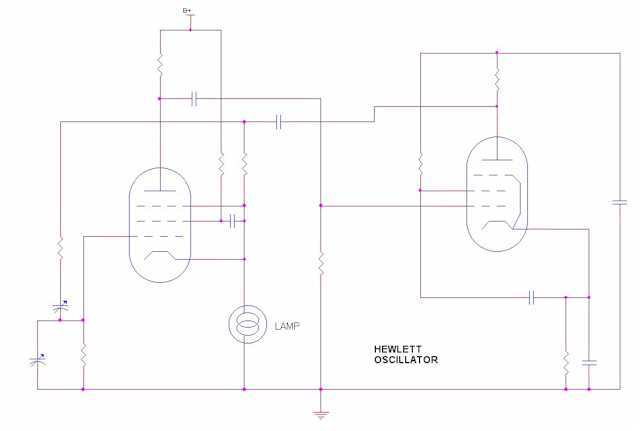
In effect, a Wein Bridge oscillator consists of two simple first order filter networks implemented with resistors and capacitors. One such network is a low pass filter and the other is a high pass filter. They are then connected in series and connected to ground. The point at which the two networks cross over consists of a single frequency which is not passed to ground, this is then amplified and fed back (using positive feedback) to cause oscillation. The frequency of oscillation is reduced to 1/3 of its normal operating voltage by the filter networks (other frequencies are reduced by much more) and so requires a gain of at least 3 to restore it to the required level for continuous oscillation. However the situation is not quite as simple as this. To compensate for circuit influences and to ensure stable operation, the initial gain needs to be a bit higher to make sure the oscillation actually starts reliably. Once it is operating however, greater waveform purity and stability is achieved by throttling back the gain a little and then by using some sort of feedback mechanism to strictly maintain the gain at the optimum level. It was this variable gain element that Hewlett invented.
In operation, the Wein bridge is arguably the best of all possible oscillators in terms of waveform purity (low harmonic distortion) - even better than crystal oscillators - and is also one of the most stable of all oscillators. Given ongoing problems with frequency stability it was inevitable that Hoyland and Rife would want to use one of these oscillators.
The Hewlett Packard Story
The story of Hewlett's invention and the formation of Hewlett Packard doesn't start with either Hewlett or Packard! It really starts with a man called Frederick Emmons Terman. Terman was the son of the famous Stanford university professor Lewis Terman who was renowned for his work with gifted children and developments of ways to measure IQ, i.e. the Stanford-Binet IQ test. Lewis Terman had tuberculosis and suffered greatly from it throughout his life. Frederick Termon also contracted tuberculosis in 1924 - which effectively made him bed ridden for at least a year, he was 24 years old at the time. Frederick Termon was unusual however. Since the age of 14 he had been an avid radio amateur. He had achieved a degree in Electrical Engineering but presumably under his father's influence, was also a polymath and was convinced that he should master a number of cross-disciplines, one of which was chemistry. Termon was very interested in the idea of promoting cross-fertilisation of the sciences and had very strong ideas about how to foster scientific development. When his tuberculosis laid him up in 1924, Termon spent his time studying intensively, mainly in electronics and electrical engineering but also in other fields as well. He had contact with many other famous scientists of the time, including Lee De Forest.
In 1927, Terman became a teacher of electronics at Stanford following a sudden and somewhat miraculous recovery from his tuberculosis. The reasons for this are not documented anywhere that I have found - but it makes one wonder whether Rife may have been involved with that. Clearly they had mutual associates such as De Forest, and Rife's skill would almost certainly have attracted the attention of someone like Terman - conversely, Terman's skill in electrical engineering including plasma physics would almost certainly have attracted the attention of someone like Rife. But I have not found any obvious connection between them.
In 1933, Terman became acquainted with a student called David Packard. Packard was an undergraduate but wanted to take one of Terman's post graduate courses in electronics. Terman admitted him because of their mutual interest in ham radio. Through Packard, Terman became acquainted with Packard's best friend, William Hewlett - who was also a student at Stanford. Terman was interested in pushing new developments in electronic and radio related areas. In an interview in 1973, Terman recalled that what made Hewlett outstanding was his interest in medical electronics. Terman considered Hewlett to be extremely intelligent, energetic and persistent. He thought that Hewlett was initially quite a clumsy designer, but through sheer persistence, Hewlett would come up with better and better designs until he got some feel for the field, when he started producing really innovative designs. Terman recalled two early designs of Hewlett's that impressed him - a machine to record brainwaves, and some sort of diathermy machine.
It is very interesting to note the latter at this point. Diathermy machines were in vogue at the time, and many of the newer ones consisted of plasma tubes driven by radio frequency transmitters. In other words, there was not a great difference between a Rife machine and a diathermy machine. So again it begs a question: could Hewlett have been involved in the development of the Rife machines? Terman, Packard and Hewlett were all directly or peripherally involved with radio amateur clubs in California area in the mid 1930's - Phillip Hoyland was also a practising radio engineer and would presumably have been in contact with similar clubs at the same time in the same general area - could it be that they knew each other?
Anyway, Hewlett and Packard graduated in 1934. Packard went on work for General Electric - in the field of vacuum tube development. Hewlett went to MIT. In 1936, Hewlett returned to Stanford to take a Master's degree in Electrical Engineering - he was of course in Terman's class. Packard also kept in contact with Terman as well, and of course remained close friends with Hewlett. Terman recalls that he often acted as an intermediary for the two during that period, passing messages back and forth from one to the other. It was also during this period that Hewlett built his diathermy machine, and also was the period in which Beam Rays was founded.
To complete his Master's degree, Hewlett had to write a thesis. Terman at that time was encouraging research into negative feedback techniques and this became the subject of many brainstorming sessions between the three, Terman, Hewlett and Packard. So it was quite natural that Terman would encourage Hewlett to prepare a thesis on negative feedback. Terman was very interested in a design by someone from General Radio. It was for a fixed frequency oscillator that used negative feedback. Terman speculated on whether it was possible to make a true variable frequency oscillator by inserting a tuning capacitor into the circuit - however this was not so easy because to do so introduced instabilities into the circuit. Terman recalled that he was very interested in the development of a good quality, stable audio oscillator for lab work, because at that time (around late 1937) the depression had started and commercial equipment had become very expensive to buy. So he gave the General Radio design to Hewlett and suggested that if he could find some way of solving the stability issue through better control of negative feedback, this would make a really good subject for a Master's thesis.
It was here that Hewlett made his great breakthrough. In order to control the gain of the circuit in a linear fashion, he hit upon the idea of using a simple incandescent electric light bulb in the feedback circuit. It was this element that made the variable frequency Wein Bridge a practical reality. In 1938, Hewlett then wrote his thesis on this and built a simple prototype. Hewlett subsequently gave a public lecture at Stanford on the design, and took the prototype to at least one radio convention where he showed off the design in autumn 1938. There are apparently conflicting accounts of the latter which may not actually be conflicting, it may be just a question of detail, or there may have been more than one such convention. One account notes that it was an IEEE convention, Packard says that it was a Institute of Radio Engineers convention in Portland Oregon, and Terman says it was simply a convention "here on the Pacific Coast". Either way the Hewlett design was well publicised.
In August 1938, Packard took a leave of absence from GE (where he was paid $110 per week) and returned to Stanford to take up a job for $55 a week at Terman's insistence. Terman wanted Hewlett and Packard to set up a company to start marketing their inventions (they had several other joint inventions by that time) - but in particular Terman thought the oscillator was a good starting point.
In January 1939, Hewlett and Packard set up a company, Hewlett-Packard and started marketing the new oscillator. They rented a property in Palo Alto - 367 Addison Avenue - where Packard and his wife lived in the lower part of the house (with the landlady upstairs) and Hewlett lived in a cottage at the bottom of the garden. They set up shop in the garage and started producing and selling the oscillator for $54.40. Hewlett applied for a patent on his design (US Patent number 2,268,872) on July 11 1939 - which was after the Beam Rays machine had already been produced - so at the time the Beam Rays machine was made, the design had not been patented. Their big business break came when Walt Disney studios required audio oscillators for special effects in the movie Fantasia. They managed to sell 8 oscillators to Walt Disney and after this, their fame spread. By autumn 1939 they had made some $5,000 and were able to rent a larger building in Page Mill Road, just back from El Camino.
Terman too went on to become famous in his own right. He is nowadays regarded as the "Father of Silicon Valley" because he encouraged the idea of the development of a "science park" near San Francisco which later developed into Silicon Valley. He was also the author of numerous reference works in electrical engineering.
Connection to Beam Rays
There is no actual documented connection between either Terman, Hewlett or Packard and Rife, Hoyland or Beam Rays that I have yet been able to find. However the probability of such a connection is high given the many mutual associations between various parties. Hewlett's interest in medical devices and radio applications, combined with his avid interest in magazine and newspaper reports (according to Terman) must have at least informed him about Rife at some stage. Terman's own interest in the same areas, including the effect of radio waves on microorganisms also tends to imply some connection.
The fact remains that the Beam Rays machine uses a first generation Hewlett Wein Bridge oscillator - and the Beam Rays machine was produced shortly after Hewlett invented it, and before he patented it. This leads to a couple of possible conclusions - that either Beam Rays "stole" the design from Hewlett, or that they had some sort of tacit licensing agreement. If they were friends of course it may have just been an informal agreement. I am informed by Jim Bare that Hewlett Packard does not have any record of any licensing agreement with Beam Rays - however this does not prevent some friendly informal agreement, or even a formal one for which the paperwork has been lost. If such a formal agreement existed it would have been prior even to the founding of Hewlett Packard when Hewlett and Packard were living in rented accommodation and working out of a garage - so there is a strong chance of such papers being misplaced. It would also have been of no importance to them after the demise of the Beam Ray Corporation.
(c) Copyright Aubrey Scoon 2002-2009 - Mirror of information from www.scoon.co.uk
The opinions stated on this page are those of Aubrey Scoon (1960-2009). They do not necessarily reflect the opinions of anyone else assocaited with www.rife.de.