
Using Heat Against Cancer

The German medical journal, "Biomed Park", published by the Klaus Hartmann Verlag, published an interesting article, which gives some insights into the equipment.
I have obtained permission to release this article on the Internet. I have translated this report from the original German into English. You can view the English version in PDF form here.
Using Heat Against Cancer
The Hungarian company OncoTherm makes use of the effect of electric fields
alongside the classic hyperthermia method
Hyperthermia has been in use for more than 2000 years. The Greek philosopher and doctor Hippocrates said: "Who cannot cure disease with medicine, should operate. Who cannot operate, should heal with heat." It is claimed that he used heat to treat breast tumours.
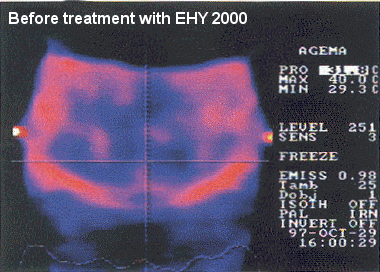
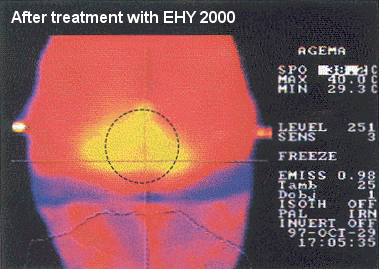
In the 60s, the whole body hyperthermia method was rediscovered, and studies on this form of therapy, have been made since the 70s. The technical prerequisites for the clinical hyperthermia have been developed in the last few years although conventional medicine often reacted disapprovingly to what they called Quack medicine. In the meantime, modern hyperthermia methods have begun to separate themselves from this bad reputation. In a number of clinics, practices and institutes, Oncologists are already working with hyperthermia. Even the German health insurance system (Krankenkassen) are taking this form of therapy seriously and accepting the costs. Even so, the method is still controversial. The problematic is that "The current situation with oncologists hyperthermia is comparable with that of radiotherapy at the time it was discovered: We know that it is a method to use, however the correct dosage, the limits of its use, the optimal conditions for treatment and the exact effects have not been clarified. Only long-term studies can answers these issues," explained Prof. András Szász, director of the Hungarian Onco-Therm (HOT).
Fundamental research into hyperthermia has made significant advances in recent years and part of the physiological and biochemical mechanisms are now better understood. Prof. András Szász explained the foundations hyperthermia is based on: Tumour tissue is more sensitive to overheating than healthy tissue as it is less well supplied with blood. Surrounding healthy tissue can cope with the heat by increasing the circulation. Additionally, tumour cells have a faster metabolism and the heat speeds it up even further causing the cell to heat itself up even more. This high rate of metabolism combined with the poor blood supply causes the tumour cells to suffer from lack of oxygen. This causes acidosis, which damages the affected cells. This method has few side effects and is painless for the patient.
There are currently two different methods being used. With the whole body hyperthermia method, the entire body is systematically heated up to a temperature of up to 42°C. This method is used in particular to treat metastasis and advanced tumours. The local and regional hyperthermia is used to only heat the tumours and tumour regions. There are a number of companies offering hyperthermia systems, worldwide, using a various methods of transferring the heat to the body: Electrical energy, microwaves, infra-red, radio waves as well as electrical, magnetic and electromagnetic fields. The method HOT has chosen, is to apply hyperthermia with short waves and they named the method "Oncothermia." The small company has its roots in Hungary where it was formed in 1993 out of the research projects of the technical Eotvos University and the university clinics of the Semmelweis University in Budapest. Apart from its flagship, the local-regional Oncothermia system EHY2000, OncoTherm also offer a unit for the invasive electro-chemical tumour therapy and a whole body hyperthermia device that uses infra-red waves. Additionally, the PCT2000 is a intracavitarial Oncotherapy system on the market. The short wave emitter is inserted into natural cavities with a catheter. For example, the emitter can be positioned in the prostate via the urinary tract.
The local-regional Oncothermia system EHY2000 uses short waves at a frequency of 13.56Mhz with modulated low-frequency waves. The patient is, in other words, the dielectric between the plates of a capacitor - and therefore part of a resonant power circuit. "Through this system, the treatment can be easily matched exactly to the patient " as Prof. Szász, explained. In the patient's malignant tissue, a temperature can be achieved, during the treatment, of over 42°C. Besides the heat treatment; the induced electrical field plays an important part in Oncothermia. "The electric fields can be applied in such a way that they only affect the extra-cellular area and do not penetrate the cytoplasm. This is achieved through a using a field strength that lies far below membrane potential. The warmth only penetrates slowly into the inner part of the cell by thermal diffusion from the extra-cellular matrix. The modulated low frequency field destabilises the cell membrane."
Critics criticize that hyperthermia can also destroy healthy tissue. Szász counters that Oncothermia has a high selectivity for tumour tissues. "Due to the different dielectric properties of healthy and malignant tissues, the specific energy absorption rate is differs significantly. Under the conditions that prevail during the use of our method, the malignant tissue absorbs about 5-20 times more energy." In contrast to the microwave method, for example, no hot spots can be caused in healthy tissue and therefore cannot harm it.
Dr. Caius Popa, manager of the hyperthermia department in the BioMed clinic, Bad Bergzabern (Germany), has been working with four EHY 2000 units for about 2½ years. "We use this method for all soft-tissue tumours in combination with chemo and radiation therapy. Advantage: We can use a lower dosage thereby improve the patient's quality of life" reports Popa. "Besides this, the units are very easy to operate and can be quickly set for the treatment of the various organs and it allows us to work very precisely and reliably. As we treat 40 patients daily, we also rely on the good and fast service."
Hyperthermia - Not Quack medicine after all?
Outside lecturer Dr. Rüdiger Wessalowski of the clinic for Pediatric Haematology and Oncology in the University Clinic Düsseldorf (Germany) states: "That hyperthermia is so controversial lies in the fact that there were so many charlatans that used this method in an uncontrolled way. However, serious studies show that such treatment can be meaningful for various diseases." It has been accepted many times, that hyperthermia can improve the effectiveness radio and /or chemotherapy. Clinical studies in the phases II and III, for example that of Prof. Dr. R. D. Issels of the clinic in Grosshadern (Germany), verify the effectiveness. Additionally, hyperthermia reduces pain and stimulates the immune reaction against tumour cells. The treatment of tumours with hyperthermia will surely be a meaningful supplement to radiation and chemotherapy in future. It could also achieve significance as a pre- or post-operative supplementary therapy. The Oncotherapy, that goes one step further than classical hyperthermia in that it uses the effect of electrical fields in addition to warmth, must now prove whether and which additional benefits it brings.
At the Chair for Radiology and Micro-therapy, University of Witten/ Herdecke (Germany), Prof. Dr. Dietrich H. W. Grönemeyer's group has been working with hyperthermia for some years. Assistant Doctor Hüseyin Sahinbas reports on the therapy results.
Bmp: How long have you been using Electro-Hyperthermia and which unit do you use?
Sahinbas: Since September 1999. We use the loco-regional Oncotherapy unit EHY 2000. After preliminary tests on dummies and based on the experiences of the users till then, we started to use the therapy on our patients in March 2000.
Bmp: Do you use this therapy on its own, or in combination with other therapy forms?
Sahinbas: In general, hyperthermia is used in combination with chemotherapeutics and/or radiation therapy with an interval and/or in parallel in order to optimise the effectiveness of the therapy. The therapy is administered about 12 to 14 times, in one region for about an hour.
Bmp: Where are the advantages in this form of therapy?
Sahinbas: So far, no side effects worth mentioning have been observed. At the moment, we have observed no limitations for the local-regional deep hyperthermia in its use as a supporting therapy. Even brain tumours, for example, can be treated without any side effects.
Bmp: Which problems still need to be solved?
Sahinbas: The effectiveness of deep hyperthermia and specific tumours could be researched, for example in combination with magnetic resonance imaging (MRI). As this form of therapy has worked without any noticeable side-effects, a unit to treat the entire body would be desirable, that is based on this technology. That would allow us to effectively treat larger areas, e.g. with diffuse secondary growths, without having a negative affect on the patient's quality of life.
Bmp: Hyperthermia is a very controversial method. What would you answer to a critic?
Sahinbas: There are more that 27000 national and international publications in connection with hyperthermia. At present, studies are taking place for many types of tumour and regional Phase II and Phase III studies are underway. The results are encouraging. Further research is however necessary.
Bmp: A short outlook?
Sahinbas: All our patients so far have been exclusively patients suffering with far advanced tumours and secondary growths in combination with conventional therapy. Our results so far show at least an improvement in the quality of life. For this reason, the status of hyperthermia should be especially researched on predefined patient groups.
"Who cannot cure disease with medicine, should operate.
Who cannot operate, should heal with heat."
Hippocrates
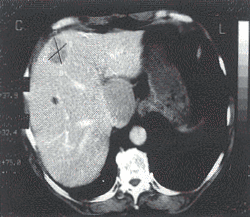
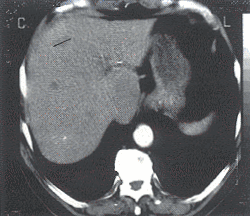
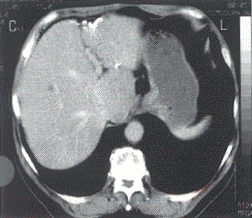
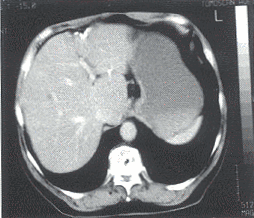
Pictures 1-4: Computerized (cranial) tomography of the abdomen from a 76 year old patient with hepatic metastatic carcinoid during a local-regional deep hyperthermia treatment with the Oncotherapy system EHY 2000. The case study was conducted in collaboration with the institute for Micro-therapy, Prof. Dr. Grönemeyer, University of Witten/Herdecke (Germany).
Interview: Kristin Mödefessel-Herrmann for the Biomed park medical journal (6/2001 p. 39-41), Germany
Shown here by permission of the Klaus Hartmann Verlag. Mirroring or other sites, etc prohibited.
Conclusions:
OncoTherm have shown that it is both possible and advantagous to use Rife therapy in mainstream medicine.
To find out more about OncoTherm, have a look at their website: http://www.hot-oncotherm.com