
What has become of the Rife Microscope
Microscope
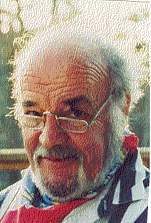
Christopher Bird (1928-1996)
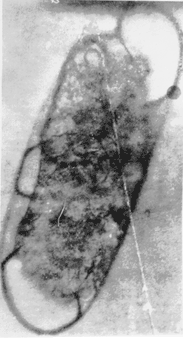
Typhoid Bacillus (The Universal Microscope).
22,000x on 35mm film, enlarged 300,000x
22,000x on 35mm film, enlarged 300,000x
The following article by Christopher Bird is looked upon as one of the key articles responsible for making the Rife microscope known today. This article is hard to find on the internet and we are glad to be able to release it here. We have tried to show the article here as close as possible to how it was originally published.
What has become of the Rife Microscope?
Written by Christopher Bird
New Age Journal, Boston, March 1976, pp 41-47
This article, like an embryo or any living thing, is still growing. A continuation of this growth may depend upon the assistance of NAJ readers, their colleagues and their friends.
Originally I intended to write a short note on what was known about the Rife microscope. Precious little is in print on the subject.
One day, while waiting for some material to come up from the cellar-stacks of the National Library of Medicine in Bethesda, Maryland, considerably frustrated by the lack of leads and data concerning the demise of the Rife microscope. I wandered by the Subject Card Catalogue and casually flipped at random to a card in the middle of a drawer labeled "Microscopes.."
The card was filed under "Allied Industries" as if that firm were the author. The company's address was stated to be 4246 Pepper Drive, San Diego, California. The title referenced was "History of the Development of a Successful Treatment for Cancer and Other Virus, Bacteria and Fungi."
At the bottom of the card was a single line: "Written by Dr. R.R. Rife."
Entirely by accident I had stumbled upon what looked to be only one of a series of reports written by Royal Raymond Rife. Fourteen pages long. it was numbered Dev-1042. It was approved and signed by J.F. Crane, Manager; Don Tully, Development Associate; and Verne Thompson, Chief Electrical Engineer.
Are any of these gentlemen alive today?
Was Allied Industries a research corporation established by Rife?
How many other reports did it publish and where are they?
The report so riveted my attention that I was compelled to explore some of the history of microbiology and its connection to cancer and other disease. The present article, much longer than originally planned, is thus the result of a fortuitous finding - perhaps an example of what Jung has called "synchronicity" - and the consequent preliminary exploration.
Much more needs to be done to tell the story of Rife and his microscope. A fascinating episode in the history of science.
The Microscope of Microscopes
In February 1944 the Franklin Institute of Philadelphia published an article, "The New Microscopes," in its prestigious journal devoted to applied science. Founded in 1824 by "philosophermechanics," the institute, which recently made studies in its physics laboratory on the best way to move the Liberty Bell. to its new Bicentennial Year location, is a smaller analog of the huge world-famous Smithsonian Institution in Washington, D.C. which reprinted the same article in its own journal shortly after its first appearance.
Authored by R.E. Seidel, M.D., a. Philadelphia physician and his research assistant, M. Elizabeth Winter, the essay opened with a six-page discussion of the electron microscope, which had only recently been put on the market by the Radio Corporation of America.
This microscope is today standard equipment in modern laboratories.
The article closed with a ten-page treatment of a "Universal Microscope," the brainchild of a San Diego autodidact, Royal Raymond Rife, who developed it with the financial assistance of the roller bearing and axle magnate Henry H. Timken, for whose family Rife at one time served as handyman and chauffeur.
Rife's scope, the largest model of which consisted of 5,682 parts and required a large bench to accommodate it, overcame the greatest disadvantage of the electron microscope, its inability - because tiny living organisms put in it are in vacuum and subject to protoplasmic changes induced by a virtual hailstorm of electrons - to reveal specimens in their natural living state.
With his invention Rife was able to look at living organisms. What he saw convinced him that germs could be not the cause, but the result of disease; that depending on its state, the body could convert a harmless bacterium into a lethal pathogen; that such pathogens could be instantly killed, each by a specific frequency of light; and that cells, regarded as the irreducible building-blocks of living matter, are actually composed of smaller cells, themselves made up of even smaller cells, this process continuing with higher and higher magnification in a sixteen-step, stage-by-stage journey in-to the micro-beyond.
Though with the aid of Rife's device, thousands of still pictures and hundreds of feet of movie film were made to reveal these facts, all of this material and the Rife microscopes seem to have disappeared without a trace.
Or have they?
Calls to the U.S. Armed Forces Institute of Pathology Medical Museum, which has hundreds of different microscopes in its historical collection, to the National Library of Medicine's historical Division, to the Smithsonian Institution and the Frankin Institute, both repositories for outstanding scientific inventions, and to a dozen establishments dealing daily in microscopy elicited from curators, medical pathologists, physicians and other scientific specialists only the complaint that none of them had ever heard of Royal Raymond Rife and his microscope.
What has become of the Rife microscope?
The question is not rhetorical for if even half of the possibilities described for this astounding discovery, are true, a massive effort to hunt it down and reactivate its potential might not only save billions of dollars in biological and medical research but open a fascinating new vista onto the nature of life.
From the start, Rife's main goal was to find cures for disease, especially the most intractable of all diseases, cancer. Because he had a hunch that some as yet undiscovered micro-organism would prove to play a crucial role in the onset of this malignancy, he tried unsuccessfully to find one by observing all types of malignant tissue with a variety of standard research microscopes.
In the 1920's it became obvious to Rife that a better means of scrutinizing the micro-world than had been developed was indispensable. During that decade he designed and built five microscopes with a range from 5,000 to 50,000 diameters at a time when the best laboratory microscopes in use could achieve not more than 2,000 diameters of magnification.
At the Rife Research Laboratory on Point Loma, California, he worked at magnifications of 17,000 and higher, to-reveal a host of cells and microorganisms never before seen and to photograph them. The work required a saint's patience. It could take the best part of a day to bring a single target specimen into focus.
The Rife microscope has several arresting features. Its entire optical system of fourteen lenses and prisms, as well as an illuminating unit, were made of crystal quartz which is transparent to ultra-violet radiation. In the scope, light was bent and polarized in such a way that a specimen could be illuminated by extremely narrow parts of the whole spectrum, one part at a time, and even by a single frequency of light.
Rife maintained that he could thus select a specific frequency, or frequencies, of light which coordinated and resonated with a specimen's chemical constituents so that a given specimen would emit its own light of a characteristic and unique color. Specimens could be easily identified, thus solving one of microscopy's greatest bugaboos. It was control of Illumination which turned the tricks of light.
Another feature was the microscope's extraordinary resolution, its ability to reveal the most minute of component parts of any specimen so that each may be seen distinctly and separately from the others. Imagine two extremely thin parallel lines. When they can be clearly distinguished you are still within the microscope's range of resolution. If the parallel lines blur together, high magnification will only enlarge the distortion and limit of resolution has been attained. With a resolving power of 31,000 diameters - as against 2,000 to 2,500 for the laboratory microscopes in common use in that day - Rife's device could focus clearly on five lines of a standardized grid, whereas an ordinary microscope could do no better than examine fifty lines, and that with considerable aberration.
This is somewhat equivalent to one aerial camera's being able to spot individual houses in city blocks from a very great height while another is able only fuzzily to distinguish the single city blocks themselves.
Controversial Discoveries
Beginning in the 1920's and continuing over seven years, Rife and his colleagues worked on more than 20,000 laboratory cultures of cancer obtained from the Paradise Valley Sanitarium in National City, California, in what appeared at first to be a fruitless effort to isolate micro-organisms which he felt should somehow be associated with the disease.
Up to then bacteria had clearly been proved to be linked with a wide variety of ills including tuberculosis, leprosy, cholera, gonorrhea. syphilis, typhoid, bubonic plague, pneumonia and others. But no one had found them in association with cancer.
In contrast to the much smaller viruses, bacteria were widely considered to be unicellular, monomorphic - meaning one shape and one shape only - forms. A quarter of a million of them can occupy a space no larger than the period at the end of this sentence. They come in various shapes. Cocci are round, bacilli rod-like, to offer but two examples.
There are various forms for each shape. Of the round-shaped ones, monococci appear singly, diplococci conic in pairs. staphylococci in clusters resembling a bunch of grapes, streptococci. which under certain conditions can produce a painful sore throat in chains.
While outside a host, or body, bacteria are hard to raise, or culture. Each type has been studied as a pure culture only by isolating it upon a specific nutrient, called media.
Bacteria also have specific maximum, minimum, and optimum temperatures at which they will live and multiply. Some, like polar bears, are addicted to Artic temperatures and even live in Ice. Other: prefer water so hot It would kill most animals. A great many enjoy the temperature of the human body. Millions of them are living, harmlessly, inside, you right now.
But they are not always harmless. They can acquire virulence, or the power to cause disease under some conditions but not others, although even today no one knows exactly why.
This mystery, in the 1920's, was closely connected to a debate in microbiology so hot as to seem almost like a war. On one side were those who affirmed as do many textbooks today, that bacteria were eternally monomorphic. They could not assume other or smaller forms, as small, say, as a virus.
Originally, virus - the word means 'poison' in Latin - was the name generally applied to any microscopic agent injurious to living cells. Now it is much more narrowly defined as "one of a unique group of very small infectious agents that grow only in cells of animals (including humans), plants and also bacteria"
Because they were so small, viruses would pass through filters which did not allow the passage of bacteria, said to be monomorphic, just as a net of small enough mesh will allow minnows to pass through it but bring the fish that are preying upon them up short. It is this filter-passing ability of viruses, which is widely held today - along with their inability to grow on artificial media - to be one of the main criteria separating them from bacteria.
For several decades, however, another school of microbiologists maintained that, far from holding everlastingly to one shape, bacteria were pleomorphic or form-changing, they could be caused, under the right conditions of culture, to metamorphize into forms small enough to pass through filters just like viruses.
Because of their sharp disagreement on the filtrability of bacteria, the two camps came to be called "filtrationist" and "non-filtrationist."
One of the earliest of the. filtrationists was a Swedish physician arid explorer, Ernst Bernhard Almquist, for whom islands off the north Siberian coast are named. Almquist made hundreds of observations of pleomorphic bacteria in his laboratory as did researchers in Italy, Russia, France, Germany and the United States. In 1922, after two decades of work, Almquist came to the conclusion that "nobody can pretend to know the complete life cycle and all the varieties of even a single bacterial species. It would be an assumption to think so."
Way back in 1914, the American bacteriologist, Dr. Edward C. Rosenow, had the gall to assert that bacteria were not unalterable and that various strains, or what one might call sub-sub-species of them, could, when suitably treated, become any of the other strains. It was Rosenow's contention; too that he found a form of the streptococcus bacterium which caused poliomyelitis, commonly known as infantile paralysis.
What Rife's opinions were about this heated controversy are not known. He followed the standard bacteriological practice of the day, first implanting small patches of cancer tissues on various nutritive media including a special "K" medium developed by another filtrationist, Dr. Arthur Isaac Kendall, at the Northwestern University School of Medicine in Chicago, Illinois. The medium, which bore the first letter of Kendall's name, seemed to have the faculty of transforming bacteria into the transitional forms alleged for them by the filtrationist school.
No matter how often he changed menus for his sought-after cancer microbe, no matter how he altered the temperature of incubation, Rife seemed unable to coax it to appear in his, cultures.
It was apparently only when, as result of his continuing physical experimentation with the effects of light frequencies, he discovered that many microbes respond to the effects of light from noble gases, such as neon, xenon and argon, by changing their growth patterns that Rife hit upon a solution to the problem that was nagging him.
He placed a sealed test-tube containing cancer tissue into a closed loop filled with argon gas. After creating a vacuum within the loop, he charged the gas with electricity, just as one does when one throws the switch to light up the neon lamps in modern offices, though in Rife's case the charge was 5000 volts. While he still could not reveal any microbes, he noted a certain cloudiness in the nutritive medium which, through chemical analysis, he ascribed to ionization caused by the electronic bombardment.
Readers may well wonder why he adopted so strange and novel a process. The question is just as unanswerable as if put about Rife's next step: in order, he said, to counter the ionization, he placed the tube into a two-inch water vacuum and heated it for twenty-four hours at near body temperature.
Under his microscope, at 20,000X, the tube now teemed with animated forms measuring only 1/20 by 1/15 of a micron - much smaller than any known bacteria. They refracted a purplish-red color in the specific light beam.
He called this form Bacillus X and, later, because it was so much smaller than other bacilli, and perhaps because of the filterability controversy, BX virus. This problem of nomenclature can be resolved herein by referring to Rife's organism as a BX form, or simply BX.
Rife writes that "this method of ionization and oxidation brought the chemical refraction of BX out of the ultraviolet and into the visible band of the spectrum. Owing to the fact that the test-tube specimens had gone through so many trials, we again started from scratch and repeated this method 104 consecutive times with identical results."
Because he could culture his BX form, so small it would pass through any filter, he seemed to have discovered a filterable form of a bacterium. But just finding bacteria, even in filterable form, in a human tumor does not necessarily imply that they are its cause. To make sure, it is held they must be reinjected into animals and seen to cause the same or nearly similar disease, after which they must then be reisolated and shown to resemble the original organism. These were the postulates propounded by the German pioneer bacteriologist, Robert Koch, who proved that tuberculosis was apparently caused by the tubercule bacillus.
Following this accepted procedure, Rife inoculated the new BX forms into over 400 rats in all of which there subsequently appeared "tumors with all the true pathology of neoplastic tissue." Some of the tumors became so large they exceeded the total weight of the individual rats in which they were developing. When the tumors were surgically removed, the BX form was recovered from them in all cases. Koch's postulates were fulfilled.
More Startling Discoveries
By continued microscopical study and repeated photography to stop their motion, Rife and his co-workers next came to the baffling conclusion that the BX, far from remaining always what he had seen as the purplish red bodies a fraction of a micron in dimension, could change into not just fairly similar forms as Rosenow had previously discovered, but into completely different forms simply by altering the medium on which they were living only very slightly.
"Slightly" in Rife's case meant an alteration in the nutrient environment of only two parts per million by volume. Those who would consider this unlikely may recall that in homeopathic medicine doses of remedies are given in dilutions of this weakness and beyond. Even though they have nothing chemically analyzable in them, they are effective.
One such alteration caused the BX to become what Rife called a Bacillus Y, or BY. It was still the same purplish-red color as the BX but so enlarged that it would not pass through a filter.
With the second change of the medium, the BY enlarged still further into a monococcoid or single disk form which, when properly stained, could be viewed under a standard research microscope. Rife claimed that these forms could be found in the blood of over 90% of cancer victims.
By removing this form from the fluid medium it inhabited and depositing it onto a hard base of asparagus or tomato agar, Rife then saw it miraculously develop into a fungus, making it kin to a yeast, mold or mushroom.
The Opposition Mounts
Any of these succeeding forms, Rife stated, could be changed back within thirty-six hours into a BX form capable of producing cancer tumors in experimental animals from which, in turn, the same BX form could again be recovered.
The transformation did not stop with the fungus which, if allowed to stand dormantly as a stock culture for a year and then replanted onto the asparagus medium, would then change into bacillus coil, millions of which live in the human intestine. This common bacillus could pass, in Rife's words, "any known laboratory method of analysis."
Because he had found that micro-organisms had the ability to luminate when stimulated by given frequencies of light it occurred to Rife that they might also be devitalized by beaming radiations of specific frequencies upon them. One source has it that the harmonics of these frequencies ranged from ten meters to twenty thousand meters.
To this end, he had been developing concurrently with his microscopic equipment a special frequency emitter which he continued to improve, up to at least 1953, as steady advances in electronics continued. The killing waves were projected through a tube filled with helium gas and said to be efficient in destroying micro-organisms at a distance of as much as one thousand feet.
With this device he noted that when the proper mortal oscillatory rate was reached, many lethal organisms such as those of tuberculosis, typhoid, leprosy, hoof-and-mouth disease and others appeared to disintegrate or "'blow up" in the field of his microscope. This "death ray" principle was' also effective when applied to cultured BX.
The obvious next step was to determine whether similar radiation would affect the BX, not in culture, but in the bodies of cancer-afflicted animals. It apparently did so, for Rife, states he got rid of BX in over 400 experimental rats and other animals in his lab. If it worked on animal cancers, wondered Rife, why not on human cancers?
The answer was so resoundingly yes that, in our day when billions are being spent each year to find a cure for cancer, it is prudent to quote Rife's report word for word: "The first clinical work on cancer was completed under the supervision of Milbank Johnson, M.D., which was set up under a special medical Research Committee of the University of Southern California. Sixteen cases were treated at the clinic for many types of malignancy. After three months, fourteen of these so called hopeless cases were signed off as clinically cured by a staff of five medical doctors and Alvin G. Foord, M.D., pathologist for the group. The treatments consisted of three minutes duration using the frequency instrument which was set on the mortal oscillatory rate for BX, or cancer, at three-day intervals. It was found that the elapsed time between treatments attains better results than cases treated daily."
The News Leaks Out
News of Rife's work began to leak out to the world of medicine at the end of the 1920's. One of the first to learn of it was Arthur W. Yale, M.D., who lived in San Diego, not far from Rife's laboratory. He acquired a frequency emitter and began to treat cancerous patients.
In 1940, reporting to his fellow physicians on some of his decade-long results, he wrote that because the whole of Rife's extraordinary findings constituted an "entirely new theory of the origin and cause of cancer, and the treatment and results have been so unique and unbelievable," he was making his findings available in the hope that "after further research we may eliminate the second largest cause of deaths in the United States
Yale had had limited success in treating cancerous tumors with X-rays and with the use of what he called "static wave current" for some three decades, when he began to use Rife's device, he sometimes employed It alone, sometimes together, with the two methods with which he was familiar. Both methods brought startlingly successful results. Yale was careful to note that, when he added the use of the Rife ray to his other radiation, cancerous masses "have disappeared in about one-tenth the time and so far with no reoccurrences."
Dr. Arthur Isaac Kendall whose "K" medium Rife had used in his experimentation, was also determined to check whether viable bacteria in the filterable state could be unequivocally seen by Rife's microscope. Kendall had been working with cultures of typhoid bacillus and, under a standard microscope, had been able to detect a swarm of active granules that could be seen only as tiny motile points. Because nothing of their individual structure could be ascertained, Kendall could not diagnose them with certainty to be filterable forms of the bacillus.
In order to make certain, he went to California in late November of 1931 and examined his cultures under a Rife microscope at 5,000 diameters in the Pathological Laboratory of the Pasadena Hospital. The facilities were afforded through the offices of the same Drs. Johnson and Foord who had worked with Rife on the BX.
When Rife finally got them in focus, the tiny granules were seen to be bright, highly motile, turquoise-blue bodies which, to quote the report he co-authored with Kendall, "contrasted strikingly both in color and in their active motion with the non-colored debris of the medium." The same observations were repeated eight separate times, the complete absence of similar bodies in uninoculated control media being noted.
To further confirm their findings, Rife and Kendall next examined eighteen-hour-old specially cultured and inoculated colonies of the same bacillus because they had determined that it was precisely at this stage of growth that they became filterable. Now they could see three transitional forms of the same organism: one, the normal bacillus itself, almost devoid of color; two, the same bacillus but with a prominent turquoise-blue granule at one end of it; and three, the same turquoise-blue granules moving about independently.
This was somewhat equivalent to being able to observe a caterpillar, its cocoon and the butterfly which emerges from the cocoon, all simultaneously.
When they transplanted the filter-passing granules into a broth medium, they were seen under the Rife microscope to revert back to their original bacillus, or rod-like, form.
At this juncture, the American bellwether journal, Science, got wind of Kendall's work and, in a news story devoted to it, referred to the new super microscope invented by Royal Raymond Rife. The same month, December 1931, the Rife-Kendall account was published in California and Western Medicine, the official mouthpiece of the state medical associations of California, Nevada, and Utah. This magazine also commented editorially that the Kendall-Rife article was to be particularly recommended to its readers because of its "calling the attention of the world to a new type of microscope which, if it fulfills its apparent advantages over any microscope thus far developed, bids fair to lay the basis for revolutionary discoveries in bacteriology and the allied sciences."
The editorial was significantly entitled: "Is a New Field About to Be Opened in the Science of Bacteriology?"
Apparently it was about to die aborning.
The Opposition Mounts
The following month Kendall was invited to give the De Lamar lecture at the John Hopkins University School of Hygiene and Public Health in Baltimore, Maryland, before the Association of American Physicians. As a leader of the filtrationist school he attracted the attention of his adversaries, two of whom were invited as discussants.
The first was an irascible, pugnacious curmudgeon, Dr. Thomas Rivers, of the well-heeled Rockefeller Institute of New York City, who was described by one of his institute colleagues as a "difficult and formidable person to oppose and could be stubbornly inflexible in maintaining a position."
When he learned of his invitation to discuss Kendall's presentation of the work with the typhoid bacillus, Rivers hurriedly repeated experiments on which Kendall had worked for years and, by his own account, got no proof of Kendall's claim. Based on this thin evidence, he arose at the Johns Hopkins meeting and, to quote him, "in a very temperate manner called the fellow a liar. Not in so many words. Actually, all I said was that I couldn't repeat this experiment and I therefore didn't believe his findings were true."
Rivers was followed in the discussion by the Harvard microbiologist, Dr. Hans Zinsser, also a "non-filtrationist," who, to quote Rivers anew, just gave Kendall bloody hell. I'd never seen Hans so hot in my life. I had to agree with everything he said - but I really felt sorry for poor old Kendall - he just sat there and took it."
In the midst of the venom and acerbity the only colleague to come to Kendall's aid was the grand old man of bacteriology, and first teacher of the subject in the United States, Dr. William H. "Popsy" Welch, who evidently looked upon Kendall's work with some regard.
What is of interest today is that at the Baltimore meeting there seemed to be no mention of the Rife microscope. Also, in light of the apparent victory of the "non-filtrationists" over those who claimed that bacteria were filterable, it was curious that Rivers could claim to have repeated Kendall's work without the use of the instrument Kendall had found so necessary to clearly reveal his filterable forms.
Kendall's work, however, attracted the rapt attention of the same Dr. Edward C. Rosenow who, in 1914, had been able to prove that strains of streptococcus were able, under the right conditions, to transmute one into the other. In that day he had written that these "conditions were more or less obscure. They seem to call forth new or latent energies which were previously not manifest and which now have gained the ascendency."
As a filtrationist, Rosenow was a maverick among bacteriologists up to his death at 94 in the 1960's. His work had convinced him, also prior to World War I, that organisms in sera - the fluids from tissues of immunized animals commonly used as antitoxins to neutralize microbes in the body - might in some patients have dangerous biological side effects.
The main implication of Rosenow's work in his own eyes was that bacteria were not as important to disease as the terrain on which they found themselves. "It would seem," he wrote in his 1914 article, "that focal infections are no longer to be looked upon merely as a place of entrance of bacteria but as a place where conditions are favorable for them to acquire the properties which give them a wide range of affinities for various structures."
Rosenow first became aware of the Rife technique through a patient at the Mayo Clinic in Rochester, Minnesota, where Rosenow was employed. The patient was none other than the same Henry H. Timken who had financially aided Rile to develop his microscope and begin his research in the 1920's.
Rife came to Chicago with his microscope. Kendall invited Rosenow down to the Northwestern University Medical School to work with himself and Rife on July 5, 1932. For three days they made a restudy of the Kendall forms, Rosenow working with a Zeiss microscope, Kendall with an oil immersion dark-field instrument, and Rife with his special device. "The oval, motile, turquoise blue bodies," wrote Rosenow of this work," described previously by Kendall and Rife were unmistakably demonstrated."
The three next decided to filter cultures of the streptococcus bacteria which Rosenow had found to be associated with poliomyelitis to see what the Rife scope might reveal. What they saw were not the blue bodies linked to the typhoid bacillus -but cocci and diplococci of a brownish-gray color each surrounded by a strange halo. These could only be observed in the Rife microscope.
Moreover filtrates of a virus considered to be the cause of encephalitis showed a considerable number of round forms, singly and in pain, which under the special Rife illumination were pale pink in color and. somewhat smaller than those seen in the poliomyelitis preparations.
Rosenow's work was panned by River in. public forum just as viciously as was Kendall's. This was before Rosenow had worked with the Rife microscope. "I had one run-in with him," said Rivers, "at a meeting held before the Association for Research in Nervous and Mental Diseases during Christmas week in 1931. I was pretty savage with him. Do you think that helped? Hell, no, if you ask me for my candid opinion, I think that most of the audience believed Rosenow."
This belief did not last for long. For a variety of reasons, including the very difficult methods of culturing the filterable forms of bacteria - and lack of the Rife microscope to observe them - the "church" of non-filtrationist bacteriology of which Rivers was later proclaimed "the apostolic father" (does one need better evidence of hierarchical priesthoods and priestcraft in science?) was putting the filtrationist camp on the defensive.
Three filtrationists, writing of discoveries similar to those of Kendall, just prior to Kendall's Johns Hopkins lecture, thus considered it necessary to state in their introduction: "It has come about these days that to express convictions that differ from the consensus gentium becomes almost professional foolhardiness: it brings down the strictures of one's friends and enemies alike."
They added: "But we are also conscious of the fact that, beneath the tumult of controversy between monomorphism and pleomorphism, there is being born a new epoch in bacteriology, the limits of the significance of which and the possible future expansion of which no one can yet surmise."
Like all scientific revolutions the epoch would have to wait patiently for its time to come. Rosenow was held by his adversaries to be 100 percent wrong in many of his observations. His son, Dr. Edward C. Rosenow Jr., chief Administrative 0fficer of the American College of Physicians, asserts that his father was all but accused by Rockefeller Institute research moguls of experimental dishonesty.
How was it that none of Kendall's or Rosenow's attackers bothered to use the Rife microscope? Rife himself admitted that he was not confident that his experiments, revealing the BX form, could ever be repeated without the use of his scope. "We do not expect any laboratory," he wrote, "to be able to produce the BX on account of the technique involved and adequate optical equipment. This is why we have never publicly announced that BX is the cause of cancer but we have succeeded in producing from its inoculation tumors with all the true characteristics and pathology of neoplastic tissue from which we have repeatedly recovered the BX virus."
At the end of his life Rosenow was philosophic about lack of acceptance for his findings among his colleagues. "There is no way," he told his son, "to convince one's peer group of something new until their attitude of receptivity changes. They simply won't listen." This echoes the German Nobel laureate in physics, Max Planck, who stated that for new ideas to be accepted, one had to wait for a generation of scientists to die off and a new one to replace it.
The Search Continues
With respect to Rife's cancer observations, it may be that this process of replacement is now taking place.
Rife's work has a possible connection with research performed over the last twenty years by several pioneers. One pair of them are Dr. Irene Diller, a former long-time associate of the Institute for Cancer Research in Philadelphia, and Dr. Florence B. Seibert, Professor Emeritus of Biochemistry, University of Pennsylvania.
One day in the late 1950's Diller called Seibert, who won many awards and five honorary doctorates for her more than thirty-year long work on tuberculosis, and asked her to come and look at some microbes on slides. On the slides Seibert observed tiny round organisms. When Seibert learned that Diller had isolated them regularly from many other tumors, as well as from the blood of leukemia patients, she hastened to ask whether her Diller could find them in a sarcoma tumor she, Seibert, was studying.
After several weeks Diller showed Seibert a tube filled with a slightly grayish and moist-looking culture filled with small round cocci. Injected into mice, they produced cancerous tumors.
Seibert became convinced that Diller might have found a link to cancer. Because so many scientists, believing DiiIer's new forms to be merely "ubiquitous contaminants" in her cultures, were writing off her work as spurious, Seibert decided to continue working on the problem during her Florida retirement, first at the Mound Park - today the Bay Front - Hospital in Saint Petersburg, later at a Veterans Adminlstration Hospital.
Blood samples from cancer patients with varying types of leukemia were obtained and from every one of them Seibert was able to isolate pleomorphic microbes. These bacterial forms were also isolated from tumors, and with an homologous vaccine they decreased tumor in mice. Just like those of the Rife-Kendall-Rosenow research, they could change from round to rod-shaped and even could become long thread-like filaments, depending on what medium they were grown and how long. They would pass a filter and at this stage in their life cycle they were about the same size as Rife's BX forms.
Today there is great stir about, and much money devoted to, viruses in relation to the cancer problem. The most recent edition of the Encyclopedia Britannica states that "sufficient evidence has been acquired to indicate that one or more viruses probably cause cancer in man," and that carcinogens, or cancer-producing agents, "are suspected of producing cancers by activating viruses latent in the body."
But so far, little support is given to those who ascribe bacteria and the forms into which they transmute the ability for close association with cancer. This legacy of the non-filtrationist school persists in the face of mounting evidence that the filtrationists may have been right all along.
These days, because various bacterial forms have been noted to have anomalies in their cellular walls - how could they develop into smaller forms if they could not leap beyond or through the walls which imprison them? - they are known as Cell Wall Deficient Forms. A revolutionary new book about them has been written by the Wayne State University microbiologist, Dr. Lida H. Mattman. Her text opens with the statement: "Clandestine, almost unrecognizable, polymorphous bacterial growth seems to occur as often as the stereotyped classical boxcars of bacilli and pearls of cocci..." The book's contents would seem to indicate that the new era predicted in 1931 for filtrationist microbiology is dawning though presently its adherents are having great difficulty both in publishing their work and getting rants for further research.
Sufficient data, writes Mattman, have been amassed to warrant reinvestigation, and adds: "There is no subject generally viewed with greater skepticism than an association between bacteria and human cancer. However, the medical profession may look back with irony at the stony reception given by his home colleagues to Koch's paper elucidating the etiology of tuberculosis. Similarly, medical students were once taught that whooping cough vaccination was an unrealistic dream reported only by two women at the Michigan Public Health Laboratories and by a pediatrician named Sauer."
Most importantly, she concludes: "One must always consider that most malignancies are accompanied by an immuno-deficiency.... Therefore, we could be dealing with a microbe that finds such a host merely a suitable environment for habitation."
This is very close to Rife's own statement that he had unequivocally demonstrated that "it was the chemical constituents and chemical radicals of an organism which enacted upon the unbalanced cell metabolism of the human body to produce disease." Before he died, Rife stated: "We have in many instances produced all the symptoms of a disease chemically in experimental animals without the inoculation of any virus or bacteria into their tissues."
What, then, of Royal Raymond Rife and his microscope?
Lingering Questions
How is it that biologists and physicians, other than Kendall and Rosenow, did not rush to investigate it? Why haven't physicists looked into the effects Rife achieved with electromagnetic waves of specific frequencies upon disease, including cancer'?
Similar effects were observed by Dr. Georges Lakhovsky in Paris who developed a wave emitter called a multi-wave oscillator with which he cured cancer in plants and humans as well as other diseases. The multi-wave oscillator is today banned by the FDA as quackery. They have also been noted in Bordeaux by another inventor, self-taught as was Rife, Antoine Priore, whose apparatus combines the use of electromagnetic radiation with a plasma of helium or noble gases reminiscent of Rife's method used in detecting and devitalizing BX.
Are the strange blue, motile forms which Dr. Wilhelm Reich discovered in the late 1930's and for which he coined the word bions related to the fore-going? Reich observed the bions to spontaneously proliferate from specially treated organic matter and even from coal and sand Spontaneous generation of life was supposed to have been laid to rest in Reich's time, as it is in ours, and he was accused by fellow scientists of confusing Brownian movement of subcellular particles or debris in his cultures with the new subcellular forms he claimed to have discovered.
In cancerous patients Reich observed the bions to degenerate into what he called T-bacilli (the T coming from the German word, Tod, meaning death). When injected into mice, they caused cancer just like Rife's BX forms.
In Copenhagen, a biophysicist, Scott Hill, reports that a new book written in Russian by two researchers at the Kazakh State University in the USSR deals with a whole new branch of medical science in which "healing" of various disorders is being accomplished by the use of ultraweak, monocromatic laser light. Shades of Rife.
The Lee Foundation for Nutritional Research in Milwaukee, Wisconsin maintains that Rife, his microscope? and his life work were tabooed by leaders in the U.S. medical profession and that any medical doctor who made use of his practical discoveries was stripped of his privileges as a member of the local medical society.
Rife himself died three or four years ago. Considerable digging has not established what happened to his estate. The remarkable instrument he conceived and developed and its photographic evidence may still be in existence. They are worth looking for.
The assistance of NAJ readers is solicited.
Der folgende Artikel von Christopher Bird gilt als einer der wichtigsten Artikel, die das Rife-Mikroskop bekannt gemacht haben. Dieser Artikel ist im Internet nur schwer zu finden und wir freuen uns, ihn hier veröffentlichen zu können. Wir haben versucht, den Artikel hier so nah wie möglich an der ursprünglichen Veröffentlichung abzubilden.
Was ist aus dem Rife-Mikroskop geworden?
Geschrieben von Christopher Bird
New Age Journal, Boston, März 1976, S. 41-47
Dieser Artikel befindet sich, wie ein Embryo oder jedes andere Lebewesen, noch im Wachstum. Eine Fortsetzung dieses Wachstums kann von der Unterstützung der Leser des NAJ, ihrer Kollegen und Freunde abhängen.
Ursprünglich hatte ich vor, eine kurze Notiz darüber zu schreiben, was über das Rife-Mikroskop bekannt ist. Über dieses Thema ist nur sehr wenig gedruckt worden.
Eines Tages, als ich darauf wartete, dass etwas Material aus den Kellerregalen der National Library of Medicine in Bethesda, Maryland, auftaucht, war ich sehr frustriert über den Mangel an Hinweisen und Daten über den Untergang des Rife-Mikroskops. Ich schlenderte durch den Subject Card Catalogue und blätterte zufällig zu einer Karte in der Mitte einer Schublade mit der Aufschrift "Microscopes".
Die Karte war unter "Allied Industries" abgelegt, als ob diese Firma der Urheber wäre. Die Adresse des Unternehmens war mit 4246 Pepper Drive, San Diego, Kalifornien, angegeben. Der Titel lautete "Geschichte der Entwicklung einer erfolgreichen Behandlung von Krebs und anderen Viren, Bakterien und Pilzen".
Am unteren Rand der Karte befand sich eine einzelne Zeile: "Geschrieben von Dr. R.R. Rife".
Ganz zufällig war ich auf etwas gestoßen, das nur einer aus einer Reihe von Berichten zu sein schien, die von Royal Raymond Rife geschrieben worden waren. Er war vierzehn Seiten lang und trug die Nummer Dev-1042. Er wurde von J.F. Crane, Manager, Don Tully, Development Associate, und Verne Thompson, Chief Electrical Engineer, genehmigt und unterzeichnet.
Ist einer dieser Herren heute noch am Leben?
War Allied Industries ein von Rife gegründetes Forschungsunternehmen?
Wie viele andere Berichte hat sie veröffentlicht und wo sind sie?
Der Bericht fesselte meine Aufmerksamkeit so sehr, dass ich mich gezwungen sah, etwas über die Geschichte der Mikrobiologie und ihre Verbindung zu Krebs und anderen Krankheiten zu erfahren. Der vorliegende Artikel, der viel länger ist als ursprünglich geplant, ist also das Ergebnis eines zufälligen Fundes - vielleicht ein Beispiel für das, was Jung als "Synchronizität" bezeichnet hat - und der sich daraus ergebenden ersten Erkundung.
Es muss noch viel mehr getan werden, um die Geschichte von Rife und seinem Mikroskop zu erzählen. Eine faszinierende Episode aus der Geschichte der Wissenschaft.
Das Mikroskop der Mikroskope
Im Februar 1944 veröffentlichte das Franklin-Institut in Philadelphia in seiner angesehenen Zeitschrift für angewandte Wissenschaft einen Artikel mit dem Titel "The New Microscopes". Das 1824 von "Philosophen und Mechanikern" gegründete Institut, das kürzlich in seinem Physiklabor Studien darüber anstellte, wie die Freiheitsglocke am besten an ihren neuen Standort im Jahr der Zweihundertjahrfeier gebracht werden könnte, ist ein kleineres Pendant zur riesigen, weltberühmten Smithsonian Institution in Washington, D.C., die denselben Artikel kurz nach seinem ersten Erscheinen in ihrer eigenen Zeitschrift nachdruckte.
Der von Dr. R. E. Seidel, einem Arzt aus Philadelphia, und seiner Assistentin M. Elizabeth Winter verfasste Aufsatz begann mit einer sechsseitigen Erörterung des Elektronenmikroskops, das erst kürzlich von der Radio Corporation of America auf den Markt gebracht worden war.
Dieses Mikroskop gehört heute zur Standardausrüstung moderner Labors.
Der Artikel schloss mit einer zehnseitigen Abhandlung über ein "Universalmikroskop", das von einem Autodidakten aus San Diego, Royal Raymond Rife, mit finanzieller Unterstützung des Wälzlager- und Achsenmagnaten Henry H. Timken entwickelt wurde, für dessen Familie Rife einst als Handlanger und Chauffeur tätig war.
Rifes Mikroskop, dessen größtes Modell aus 5.682 Teilen bestand und eine große Werkbank benötigte, um es unterzubringen, überwand den größten Nachteil des Elektronenmikroskops, nämlich seine Unfähigkeit, winzige lebende Organismen in ihrem natürlichen Zustand zu zeigen, da sie sich in einem Vakuum befinden und protoplasmatischen Veränderungen ausgesetzt sind, die durch einen regelrechten Hagel von Elektronen ausgelöst werden.
Mit seiner Erfindung war Rife in der Lage, lebende Organismen zu betrachten. Was er sah, überzeugte ihn davon, dass Keime nicht die Ursache, sondern die Folge von Krankheiten sein können; dass der Körper je nach Zustand eine harmlose Bakterie in einen tödlichen Krankheitserreger umwandeln kann; dass solche Krankheitserreger sofort abgetötet werden können, und zwar jeweils durch eine bestimmte Lichtfrequenz; und dass Zellen, die als die irreduziblen Bausteine der lebenden Materie betrachtet werden, in Wirklichkeit aus kleineren Zellen bestehen, die ihrerseits aus noch kleineren Zellen aufgebaut sind, wobei sich dieser Prozess mit immer höherer Vergrößerung in einer sechzehnstufigen Reise in das Mikro-Jenseits fortsetzt.
Obwohl mit Hilfe von Rifes Gerät Tausende von Standbildern und Hunderte von Metern Film aufgenommen wurden, um diese Tatsachen zu enthüllen, scheinen all dieses Material und die Rife-Mikroskope spurlos verschwunden zu sein.
Oder doch nicht?
Anrufe beim U.S. Armed Forces Institute of Pathology Medical Museum, das Hunderte verschiedener Mikroskope in seiner historischen Sammlung hat, bei der historischen Abteilung der National Library of Medicine, bei der Smithsonian Institution und dem Frankin Institute, beides Aufbewahrungsorte für herausragende wissenschaftliche Erfindungen, und bei einem Dutzend Einrichtungen, die sich täglich mit Mikroskopie befassen, brachten von Kuratoren, medizinischen Pathologen, Ärzten und anderen wissenschaftlichen Fachleuten nur die Klage hervor, dass keiner von ihnen jemals von Royal Raymond Rife und seinem Mikroskop gehört habe.
Was ist aus dem Rife-Mikroskop geworden?
Die Frage ist nicht rhetorisch, denn wenn auch nur die Hälfte der beschriebenen Möglichkeiten für diese erstaunliche Entdeckung wahr sind, könnte eine massive Anstrengung, es aufzuspüren und sein Potenzial zu reaktivieren, nicht nur Milliarden von Dollar in der biologischen und medizinischen Forschung einsparen, sondern auch einen faszinierenden neuen Blick auf die Natur des Lebens eröffnen.
Rifes Hauptziel war es von Anfang an, Heilmittel für Krankheiten zu finden, insbesondere für die unheilbarste aller Krankheiten, den Krebs. Da er ahnte, dass ein noch unentdeckter Mikroorganismus eine entscheidende Rolle bei der Entstehung dieser bösartigen Krankheit spielen würde, versuchte er erfolglos, diesen zu finden, indem er alle Arten von bösartigem Gewebe mit einer Vielzahl von Standard-Forschungsmikroskopen beobachtete.
In den 1920er Jahren wurde Rife klar, dass ein besseres Mittel zur Untersuchung der Mikrowelt, als es bis dahin entwickelt worden war, unerlässlich war. In diesem Jahrzehnt entwarf und baute er fünf Mikroskope mit einem Vergrößerungsbereich von 5.000 bis 50.000 Durchmessern zu einer Zeit, als die besten Labormikroskope nicht mehr als 2.000 Durchmesser an Vergrößerung erreichen konnten.
Im Rife-Forschungslabor in Point Loma, Kalifornien, arbeitete er mit Vergrößerungen von 17.000 und mehr, um eine Vielzahl von Zellen und Mikroorganismen zu entdecken und zu fotografieren, die nie zuvor gesehen worden waren. Die Arbeit erforderte die Geduld eines Heiligen. Es konnte einen ganzen Tag dauern, bis ein einziges Zielobjekt scharf gestellt war.
Das Rife-Mikroskop zeichnet sich durch mehrere bemerkenswerte Merkmale aus. Sein gesamtes optisches System aus vierzehn Linsen und Prismen sowie eine Beleuchtungseinheit waren aus Kristallquarz gefertigt, das für ultraviolette Strahlung transparent ist. In dem Gerät wurde das Licht so gebeugt und polarisiert, dass eine Probe durch extrem schmale Teile des gesamten Spektrums, einen Teil nach dem anderen und sogar durch eine einzige Lichtfrequenz beleuchtet werden konnte.
Rife behauptete, dass er auf diese Weise eine oder mehrere spezifische Lichtfrequenzen auswählen konnte, die mit den chemischen Bestandteilen einer Probe koordiniert und in Resonanz gebracht werden konnten, so dass eine bestimmte Probe ihr eigenes Licht mit einer charakteristischen und einzigartigen Farbe aussenden würde. Die Proben konnten leicht identifiziert werden, womit eines der größten Probleme der Mikroskopie gelöst war. Es war die Beleuchtungskontrolle, die die Tricks des Lichts ermöglichte.
Ein weiteres Merkmal war das außergewöhnliche Auflösungsvermögen des Mikroskops, seine Fähigkeit, die winzigsten Bestandteile einer Probe sichtbar zu machen, so dass jeder einzelne deutlich und getrennt von den anderen gesehen werden kann. Stellen Sie sich zwei extrem dünne parallele Linien vor. Wenn sie klar zu unterscheiden sind, befinden Sie sich noch innerhalb des Auflösungsbereichs des Mikroskops. Wenn die parallelen Linien ineinander verschwimmen, vergrößert eine starke Vergrößerung nur die Verzerrung, und die Grenze des Auflösungsvermögens ist erreicht. Mit einem Auflösungsvermögen von 31.000 Durchmessern - gegenüber 2.000 bis 2.500 bei den damals gebräuchlichen Labormikroskopen - konnte Rifes Gerät fünf Linien eines genormten Gitters klar fokussieren, während ein gewöhnliches Mikroskop nicht mehr als fünfzig Linien untersuchen konnte, und das mit erheblicher Aberration.
Das ist in etwa so, wie wenn eine Luftbildkamera aus großer Höhe einzelne Häuser in Stadtblöcken erkennen kann, während eine andere nur unscharf die einzelnen Stadtblöcke selbst erkennen kann.
Umstrittene Entdeckungen
In den 1920er Jahren arbeiteten Rife und seine Kollegen sieben Jahre lang an mehr als 20.000 Laborkulturen von Krebs, die sie aus dem Paradise Valley Sanitarium in National City, Kalifornien, erhalten hatten.
Bis dahin war eindeutig nachgewiesen worden, dass Bakterien mit einer Vielzahl von Krankheiten wie Tuberkulose, Lepra, Cholera, Tripper, Syphilis, Typhus, Beulenpest, Lungenentzündung und anderen in Verbindung stehen. Aber niemand hatte sie in Verbindung mit Krebs gefunden.
Im Gegensatz zu den viel kleineren Viren galten Bakterien weithin als einzellige, monomorphe - d. h. nur eine Form aufweisende - Formen. Eine Viertelmillion von ihnen kann einen Raum einnehmen, der nicht größer ist als der Punkt am Ende dieses Satzes. Es gibt sie in verschiedenen Formen. Kokken sind rund, Bazillen stäbchenförmig, um nur zwei Beispiele zu nennen.
Für jede Form gibt es verschiedene Formen. Von den runden Kokken treten Monokokken einzeln auf, Diplokokken kegelförmig in Paaren, Staphylokokken in Büscheln, die einer Weintraube ähneln, und Streptokokken, die unter bestimmten Bedingungen eine schmerzhafte Halsentzündung verursachen können, in Ketten.
Außerhalb eines Wirts oder Körpers lassen sich Bakterien nur schwer züchten oder kultivieren. Jede Art kann nur als Reinkultur untersucht werden, indem man sie auf einem bestimmten Nährboden, dem sogenannten Medium, isoliert.
Bakterien haben auch bestimmte Höchst-, Mindest- und Optimaltemperaturen, bei denen sie leben und sich vermehren können. Einige, wie die Eisbären, sind süchtig nach arktischen Temperaturen und leben sogar im Eis. Andere bevorzugen Wasser, das so heiß ist, dass es die meisten Tiere töten würde. Sehr viele mögen die Temperatur des menschlichen Körpers. Millionen von ihnen leben in diesem Moment harmlos in Ihnen.
Aber sie sind nicht immer harmlos. Unter bestimmten Bedingungen können sie virulent werden, d. h. sie können Krankheiten auslösen, unter anderen nicht, obwohl bis heute niemand genau weiß, warum.
Dieses Geheimnis war in den 1920er Jahren eng mit einer Debatte in der Mikrobiologie verbunden, die so heftig geführt wurde, dass sie fast wie ein Krieg wirkte. Auf der einen Seite standen diejenigen, die wie in vielen Lehrbüchern behaupteten, dass Bakterien ewig monomorph seien. Sie könnten keine anderen oder kleineren Formen annehmen, etwa so klein wie ein Virus.
Ursprünglich war Virus - das Wort bedeutet im Lateinischen "Gift" - die allgemeine Bezeichnung für jedes mikroskopische Agens, das lebende Zellen schädigt. Heute ist der Begriff viel enger definiert als "eine einzigartige Gruppe sehr kleiner infektiöser Erreger, die nur in Zellen von Tieren (einschließlich Menschen), Pflanzen und auch Bakterien vorkommen".
Weil sie so klein sind, können Viren durch Filter hindurchgehen, die Bakterien nicht durchlassen, also monomorph sind, so wie ein Netz, das klein genug ist, um Elritzen durchzulassen, aber die Fische, die sie jagen, nicht durchlässt. Diese Fähigkeit der Viren, den Filter zu passieren, gilt heute - neben ihrer Unfähigkeit, auf künstlichen Nährböden zu wachsen - als eines der Hauptkriterien, die sie von Bakterien unterscheiden.
Mehrere Jahrzehnte lang vertrat jedoch eine andere Schule von Mikrobiologen die Ansicht, dass Bakterien nicht ewig an einer Form festhalten, sondern pleomorph oder formveränderlich sind und dass sie unter den richtigen Kulturbedingungen dazu gebracht werden können, sich in Formen zu verwandeln, die klein genug sind, um wie Viren durch Filter zu passen.
Aufgrund ihrer scharfen Meinungsverschiedenheiten über die Filtrierbarkeit von Bakterien wurden die beiden Lager "Filtrierer" und "Nicht-Filtrierer" genannt.
Einer der frühesten Filtrierer war der schwedische Arzt und Forscher Ernst Bernhard Almquist, nach dem die Inseln vor der nordsibirischen Küste benannt sind. Almquist machte hunderte von Beobachtungen pleomorpher Bakterien in seinem Labor, ebenso wie Forscher in Italien, Russland, Frankreich, Deutschland und den Vereinigten Staaten. Nach zwei Jahrzehnten Arbeit kam Almquist 1922 zu dem Schluss, dass "niemand vorgeben kann, den vollständigen Lebenszyklus und alle Varianten auch nur einer einzigen Bakterienart zu kennen. Es wäre eine Anmaßung, dies zu glauben".
Bereits 1914 hatte der amerikanische Bakteriologe Dr. Edward C. Rosenow die Unverfrorenheit zu behaupten, dass Bakterien nicht unveränderlich seien und dass verschiedene Stämme, oder was man als Unterarten bezeichnen könnte, sich bei geeigneter Behandlung in alle anderen Stämme verwandeln könnten. Auch Rosenow behauptete, dass er eine Form des Streptokokkenbakteriums gefunden hatte, die Poliomyelitis, allgemein als Kinderlähmung bekannt, verursachte.
Was Rifes Meinung zu dieser hitzigen Kontroverse war, ist nicht bekannt. Er hielt sich an die damals übliche bakteriologische Praxis, indem er zunächst kleine Stücke Krebsgewebe auf verschiedenen Nährböden implantierte, darunter ein spezielles "K"-Medium, das von einem anderen Filtrierer, Dr. Arthur Isaac Kendall, an der Northwestern University School of Medicine in Chicago, Illinois, entwickelt worden war. Dieses Medium, das den Anfangsbuchstaben von Kendalls Namen trug, schien die Fähigkeit zu besitzen, Bakterien in die Übergangsformen zu verwandeln, die von der filtrierenden Schule für sie behauptet wurden.
Egal, wie oft er die Menüs für seine gesuchte Krebsmikrobe änderte, egal, wie er die Temperatur der Inkubation veränderte, Rife schien nicht in der Lage zu sein, sie in seinen Kulturen erscheinen zu lassen.
Erst als er bei seinen fortgesetzten physikalischen Experimenten mit der Wirkung von Lichtfrequenzen entdeckte, dass viele Mikroben auf die Wirkung von Licht aus Edelgasen wie Neon, Xenon und Argon reagieren, indem sie ihre Wachstumsmuster ändern, kam Rife auf eine Lösung für das Problem, das ihn plagte.
Er stellte ein versiegeltes Reagenzglas mit Krebsgewebe in einen geschlossenen Kreislauf, der mit Argongas gefüllt war. Nachdem er in der Schleife ein Vakuum erzeugt hatte, lud er das Gas mit Elektrizität auf, so wie man es tut, wenn man den Schalter umlegt, um die Neonlampen in modernen Büros zum Leuchten zu bringen, wobei in Rifes Fall die Ladung 5000 Volt betrug. Er konnte zwar immer noch keine Mikroben nachweisen, stellte aber eine gewisse Trübung des Nährmediums fest, die er durch chemische Analyse auf die durch den elektronischen Beschuss verursachte Ionisierung zurückführte.
Der Leser mag sich fragen, warum er ein so seltsames und neuartiges Verfahren anwandte. Die Frage ist ebenso wenig zu beantworten wie die Frage nach Rifes nächstem Schritt: Um, wie er sagte, der Ionisierung entgegenzuwirken, legte er das Röhrchen in ein zwei Zoll tiefes Wasservakuum und erhitzte es vierundzwanzig Stunden lang auf nahezu Körpertemperatur.
Unter seinem Mikroskop, bei 20.000facher Vergrößerung, wimmelte es in der Röhre nun von lebhaften Formen, die nur 1/20 mal 1/15 Mikrometer groß waren - viel kleiner als alle bekannten Bakterien. Sie brachen sich in dem spezifischen Lichtstrahl in einer purpurroten Farbe.
Er nannte diese Form Bacillus X und später, weil sie so viel kleiner als andere Bazillen war, und vielleicht wegen der Kontroverse um die Filtrierbarkeit, BX-Virus. Dieses Problem der Nomenklatur kann hier gelöst werden, indem man sich auf Rifes Organismus als BX-Form oder einfach BX bezieht.
Rife schreibt, dass "diese Methode der Ionisierung und Oxidation die chemische Brechung von BX aus dem ultravioletten in den sichtbaren Bereich des Spektrums brachte. Da die Reagenzglasproben so viele Versuche durchlaufen hatten, begannen wir wieder bei Null und wiederholten diese Methode 104 Mal hintereinander mit identischen Ergebnissen."
Da er seine BX-Form kultivieren konnte, die so klein ist, dass sie durch jeden Filter passt, schien er eine filtrierbare Form eines Bakteriums entdeckt zu haben. Aber allein die Tatsache, dass man in einem menschlichen Tumor Bakterien, selbst in filtrierbarer Form, findet, bedeutet nicht unbedingt, dass sie die Ursache sind. Um sicher zu gehen, müssen sie in Tiere injiziert werden und dort die gleiche oder eine ähnliche Krankheit auslösen, woraufhin sie erneut isoliert werden müssen, um zu zeigen, dass sie dem ursprünglichen Organismus ähneln. Dies war das Postulat des deutschen Pioniers der Bakteriologie, Robert Koch, der nachwies, dass die Tuberkulose offensichtlich durch den Tuberkelbazillus verursacht wurde.
Nach diesem anerkannten Verfahren beimpfte Rife mehr als 400 Ratten mit den neuen BX-Formen, bei denen daraufhin "Tumore mit der gesamten Pathologie von neoplastischem Gewebe" auftraten. Einige der Tumore wurden so groß, dass sie das Gesamtgewicht der einzelnen Ratten, in denen sie sich entwickelten, übertrafen. Bei der chirurgischen Entfernung der Tumore wurde in allen Fällen die BX-Form wiederhergestellt. Die Koch'schen Postulate waren erfüllt.
Weitere verblüffende Entdeckungen
Durch fortgesetzte mikroskopische Untersuchungen und wiederholtes Fotografieren, um ihre Bewegung zu stoppen, kamen Rife und seine Mitarbeiter zu der verblüffenden Schlussfolgerung, dass die BX, die bei weitem nicht immer das blieben, was er als purpurrote Körper von einem Bruchteil eines Mikrometers Größe gesehen hatte, sich nicht nur in ziemlich ähnliche Formen verwandeln konnten, wie Rosenow zuvor entdeckt hatte, sondern in völlig andere Formen, indem sie einfach das Medium, auf dem sie lebten, nur sehr geringfügig veränderten.
"Geringfügig" bedeutete in Rifes Fall eine Veränderung der Nährstoffumgebung von nur zwei Teilen pro Million Volumenprozent. Diejenigen, die dies für unwahrscheinlich halten, mögen sich daran erinnern, dass in der homöopathischen Medizin Heilmittel in Verdünnungen von dieser Schwäche und darüber hinaus verabreicht werden. Auch wenn sie nichts chemisch Analysierbares enthalten, sind sie wirksam.
Eine solche Veränderung führte dazu, dass das BX zu dem wurde, was Rife einen Bacillus Y oder BY nannte. Er hatte immer noch die gleiche violett-rote Farbe wie der BX, war aber so vergrößert, dass er nicht durch einen Filter ging.
Beim zweiten Wechsel des Mediums vergrößerte sich der BY noch weiter zu einer monokokken oder scheibenförmigen Form, die, wenn sie richtig gefärbt war, unter einem Standard-Forschungsmikroskop betrachtet werden konnte. Rife behauptete, dass diese Formen im Blut von über 90 % der Krebsopfer gefunden werden können.
Indem er diese Form aus dem flüssigen Medium, in dem sie lebte, entfernte und sie auf eine harte Unterlage aus Spargel- oder Tomatenagar legte, sah Rife, wie sie sich auf wundersame Weise zu einem Pilz entwickelte, was sie mit Hefe, Schimmel oder Pilzen verwandt machte.
Jede dieser nachfolgenden Formen, so Rife, konnte innerhalb von sechsunddreißig Stunden in eine BX-Form zurückverwandelt werden, die in der Lage war, bei Versuchstieren Krebstumore zu erzeugen, aus denen wiederum dieselbe BX-Form wiedergewonnen werden konnte.
Die Verwandlung hörte nicht mit dem Pilz auf, der sich, wenn man ihn ein Jahr lang als Stammkultur ruhen ließ und dann auf das Spargelmedium umpflanzte, in den Bacillus coil verwandelte, von dem Millionen im menschlichen Darm leben. Dieser gewöhnliche Bazillus konnte, in Rifes Worten, "jede bekannte Labormethode der Analyse" bestehen.
Da er herausgefunden hatte, dass Mikroorganismen die Fähigkeit haben, zu leuchten, wenn sie durch bestimmte Lichtfrequenzen stimuliert werden, kam Rife auf die Idee, dass sie auch durch die Bestrahlung mit bestimmten Frequenzen devitalisiert werden könnten. Einer Quelle zufolge reichten die Oberschwingungen dieser Frequenzen von zehn Metern bis zu zwanzigtausend Metern.
Zu diesem Zweck entwickelte er parallel zu seinen mikroskopischen Geräten einen speziellen Frequenzstrahler, den er bis mindestens 1953 mit den ständigen Fortschritten in der Elektronik weiter verbesserte. Die tödlichen Wellen wurden durch eine mit Heliumgas gefüllte Röhre projiziert und sollten Mikroorganismen in einer Entfernung von bis zu 1.000 Fuß wirksam zerstören.
Mit diesem Gerät stellte er fest, dass bei Erreichen der richtigen tödlichen Schwingungsrate viele tödliche Organismen wie Tuberkulose, Typhus, Lepra, Maul- und Klauenseuche und andere im Feld seines Mikroskops zu zerfallen oder zu "explodieren" schienen. Dieses Prinzip des "Todesstrahls" war auch bei kultiviertem BX wirksam.
Der naheliegende nächste Schritt bestand darin, festzustellen, ob eine ähnliche Strahlung auch auf BX einwirken würde, und zwar nicht in Kulturen, sondern in den Körpern krebskranker Tiere. Offenbar war dies der Fall, denn Rife stellte fest, dass er BX in über 400 Versuchsratten und anderen Tieren in seinem Labor loswerden konnte. Wenn es bei Krebserkrankungen von Tieren funktionierte, fragte sich Rife, warum nicht auch bei menschlichen Krebserkrankungen?
Die Antwort war so eindeutig ja, dass es in der heutigen Zeit, in der jedes Jahr Milliarden ausgegeben werden, um ein Heilmittel für Krebs zu finden, ratsam ist, Rifes Bericht Wort für Wort zu zitieren: "Die erste klinische Arbeit an Krebs wurde unter der Aufsicht von Dr. Milbank Johnson abgeschlossen, die im Rahmen eines speziellen medizinischen Forschungsausschusses der University of Southern California eingerichtet wurde. Sechzehn Fälle wurden in der Klinik für viele Arten von Malignität behandelt. Nach drei Monaten wurden vierzehn dieser so genannten hoffnungslosen Fälle von fünf Ärzten und dem Pathologen der Gruppe, Dr. Alvin G. Foord, als klinisch geheilt eingestuft. Die Behandlungen dauerten drei Minuten und wurden mit einem Frequenzmessgerät durchgeführt, das in dreitägigen Abständen auf die tödliche Schwingungsrate für BX bzw. Krebs eingestellt war. Es wurde festgestellt, dass die verstrichene Zeit zwischen den Behandlungen zu besseren Ergebnissen führt als bei täglich behandelten Fällen."
Die Nachricht sickert durch
Ende der 1920er Jahre sickerte die Nachricht von Rifes Arbeit in die Welt der Medizin. Einer der ersten, der davon erfuhr, war Arthur W. Yale, M.D., der in San Diego lebte, nicht weit von Rifes Labor entfernt. Er erwarb einen Frequenzstrahler und begann, Krebspatienten zu behandeln.
Als er 1940 seinen Ärztekollegen über einige seiner jahrzehntelangen Ergebnisse berichtete, schrieb er, dass die Gesamtheit von Rifes außergewöhnlichen Erkenntnissen eine "völlig neue Theorie über den Ursprung und die Ursache von Krebs darstelle und die Behandlung und die Ergebnisse so einzigartig und unglaublich seien", dass er seine Erkenntnisse in der Hoffnung zur Verfügung stelle, "dass wir nach weiteren Forschungen die zweitgrößte Todesursache in den Vereinigten Staaten beseitigen können".
Yale hatte seit etwa drei Jahrzehnten begrenzte Erfolge bei der Behandlung von Krebstumoren mit Röntgenstrahlen und mit der Verwendung von so genanntem "statischem Wellenstrom" erzielt, und als er begann, das Rife-Gerät zu verwenden, setzte er es manchmal allein, manchmal zusammen mit den beiden ihm bekannten Methoden ein. Beide Methoden führten zu verblüffenden Erfolgen. Yale wies darauf hin, dass Krebsgeschwüre, wenn er das Rife-Gerät zusätzlich zu seinen anderen Bestrahlungsmethoden einsetzte, "in etwa einem Zehntel der Zeit verschwanden, ohne dass es zu einem erneuten Auftreten kam."
Dr. Arthur Isaac Kendall, dessen "K"-Medium Rife in seinen Experimenten verwendet hatte, war ebenfalls entschlossen, zu prüfen, ob lebensfähige Bakterien im abfiltrierbaren Zustand eindeutig von Rifes Mikroskop gesehen werden konnten. Kendall hatte mit Kulturen von Typhusbazillen gearbeitet und konnte unter einem Standardmikroskop einen Schwarm aktiver Körnchen erkennen, die nur als winzige bewegliche Punkte zu sehen waren. Da nichts von ihrer individuellen Struktur zu erkennen war, konnte Kendall nicht mit Sicherheit diagnostizieren, dass es sich um filtrierbare Formen des Bazillus handelte.
Um sich Gewissheit zu verschaffen, reiste er Ende November 1931 nach Kalifornien und untersuchte seine Kulturen unter einem Rife-Mikroskop bei 5.000 Durchmessern im Pathologischen Labor des Pasadena Hospitals. Die Einrichtungen wurden durch die Büros der gleichen Dr. Johnson und Foord, die mit Rife auf dem BX gearbeitet hatte, zur Verfügung gestellt.
Als Rife sie schließlich im Fokus hatte, wurden die winzigen Körnchen als helle, hochbewegliche, türkisblaue Körper gesehen, die, um den Bericht zu zitieren, den er zusammen mit Kendall verfasst hatte, "sowohl in der Farbe als auch in ihrer aktiven Bewegung in auffälligem Kontrast zu den nicht gefärbten Trümmern des Mediums standen". Die gleichen Beobachtungen wurden achtmal wiederholt, wobei das völlige Fehlen ähnlicher Körper in nicht beimpften Kontrollmedien festgestellt wurde.
Um ihre Ergebnisse weiter zu bestätigen, untersuchten Rife und Kendall als nächstes achtzehn Stunden alte, speziell gezüchtete und geimpfte Kolonien desselben Bazillus, da sie festgestellt hatten, dass sie genau in diesem Wachstumsstadium filtrierbar wurden. Nun konnten sie drei Übergangsformen desselben Organismus sehen: erstens den normalen Bazillus selbst, fast ohne Farbe; zweitens denselben Bazillus, aber mit einem auffälligen türkisblauen Körnchen an einem seiner Enden; und drittens dieselben türkisblauen Körnchen, die sich unabhängig voneinander bewegen.
Das war in etwa so, als ob man eine Raupe, ihren Kokon und den Schmetterling, der aus dem Kokon schlüpft, gleichzeitig beobachten könnte.
Als sie die filtrierenden Körnchen in ein Brühe-Medium verpflanzten, konnten sie unter dem Rife-Mikroskop beobachten, wie sie in ihre ursprüngliche Bazillen- oder Stäbchenform zurückkehrten.
Zu diesem Zeitpunkt erfuhr die amerikanische Fachzeitschrift Science von Kendalls Arbeit und verwies in einem Artikel auf das von Royal Raymond Rife erfundene neue Supermikroskop. Im selben Monat, im Dezember 1931, wurde der Rife-Kendall-Bericht in California and Western Medicine, dem offiziellen Sprachrohr der staatlichen Ärzteverbände von Kalifornien, Nevada und Utah, veröffentlicht. Diese Zeitschrift kommentierte auch redaktionell, dass der Kendall-Rife-Artikel ihren Lesern besonders zu empfehlen sei, weil er "die Aufmerksamkeit der Welt auf einen neuen Mikroskoptyp lenkt, der, wenn er seine offensichtlichen Vorteile gegenüber allen bisher entwickelten Mikroskopen erfüllt, geeignet ist, die Grundlage für revolutionäre Entdeckungen in der Bakteriologie und den verwandten Wissenschaften zu legen."
Der Leitartikel trug den bezeichnenden Titel: "Wird in der Wissenschaft der Bakteriologie ein neues Feld eröffnet?"
Offensichtlich war er kurz davor, im Keim erstickt zu werden.
Die Opposition nimmt zu
Im darauffolgenden Monat wurde Kendall eingeladen, die De Lamar-Vorlesung an der John Hopkins University School of Hygiene and Public Health in Baltimore, Maryland, vor der Vereinigung amerikanischer Ärzte zu halten. Als führender Vertreter der filtrierenden Schule erregte er die Aufmerksamkeit seiner Gegner, von denen zwei als Diskutanten eingeladen wurden.
Der erste war ein jähzorniger, streitbarer Griesgram, Dr. Thomas Rivers vom wohlhabenden Rockefeller Institute in New York City, der von einem seiner Institutskollegen als eine "schwierige und furchterregende Person beschrieben wurde, der man nur schwer etwas entgegensetzen konnte und die stur auf ihrem Standpunkt beharrte".
Als er von seiner Einladung erfuhr, Kendalls Präsentation der Arbeit mit dem Typhusbazillus zu diskutieren, wiederholte Rivers eilig Experimente, an denen Kendall jahrelang gearbeitet hatte, und erhielt nach eigenen Angaben keinen Beweis für Kendalls Behauptung. Auf der Grundlage dieser dürftigen Beweise erhob er sich auf der Tagung in Johns Hopkins und nannte, um ihn zu zitieren, "den Burschen in einer sehr gemäßigten Weise einen Lügner. Nicht mit so vielen Worten. Eigentlich habe ich nur gesagt, dass ich dieses Experiment nicht wiederholen kann und deshalb nicht glaube, dass seine Ergebnisse wahr sind."
Auf Rivers folgte in der Diskussion der Harvard-Mikrobiologe Dr. Hans Zinsser, ebenfalls ein "Nicht-Filtrationist", der, um noch einmal Rivers zu zitieren, Kendall einfach die Hölle heiß machte. Ich hatte Hans noch nie in meinem Leben so heiß gesehen. Ich musste allem zustimmen, was er sagte - aber der arme alte Kendall tat mir wirklich leid - er saß einfach da und ließ es über sich ergehen."
Der einzige Kollege, der Kendall inmitten der Verbitterung zu Hilfe kam, war der große alte Mann der Bakteriologie und erste Lehrer dieses Fachs in den Vereinigten Staaten, Dr. William H. "Popsy" Welch, der Kendalls Arbeit offensichtlich mit einiger Hochachtung betrachtete.
Interessant ist heute, dass auf der Tagung in Baltimore das Rife-Mikroskop offenbar nicht erwähnt wurde. Angesichts des offensichtlichen Sieges der "Nicht-Filtratoren" über diejenigen, die behaupteten, Bakterien seien filtrierbar, war es auch merkwürdig, dass Rivers behaupten konnte, er habe Kendalls Arbeit wiederholt, ohne das Instrument zu benutzen, das Kendall für so notwendig gehalten hatte, um seine filtrierbaren Formen deutlich zu zeigen.
Kendalls Arbeit erregte jedoch die Aufmerksamkeit desselben Dr. Edward C. Rosenow, der 1914 nachweisen konnte, dass Streptokokkenstämme sich unter den richtigen Bedingungen ineinander umwandeln können. Damals hatte er geschrieben, dass diese "Bedingungen mehr oder weniger obskur sind. Sie scheinen neue oder latente Energien hervorzurufen, die vorher nicht manifest waren und nun die Oberhand gewonnen haben."
Als Filtrierer war Rosenow bis zu seinem Tod im Alter von 94 Jahren in den 1960er Jahren ein Außenseiter unter den Bakteriologen. Seine Arbeit hatte ihn bereits vor dem Ersten Weltkrieg davon überzeugt, dass Organismen in Seren - den Flüssigkeiten aus dem Gewebe immunisierter Tiere, die üblicherweise als Antitoxine zur Neutralisierung von Mikroben im Körper verwendet werden - bei manchen Patienten gefährliche biologische Nebenwirkungen haben könnten.
Die wichtigste Schlussfolgerung aus Rosenows Arbeit war in seinen Augen, dass Bakterien für Krankheiten nicht so wichtig waren wie das Terrain, auf dem sie sich befanden. "Es scheint", schrieb er in seinem Artikel von 1914, "dass fokale Infektionen nicht mehr nur als Eintrittsort von Bakterien zu betrachten sind, sondern als ein Ort, an dem die Bedingungen für sie günstig sind, um die Eigenschaften zu erwerben, die ihnen eine breite Palette von Affinitäten zu verschiedenen Strukturen verleihen."
Rosenow wurde zum ersten Mal durch einen Patienten in der Mayo-Klinik in Rochester, Minnesota, wo Rosenow beschäftigt war, auf die Rife-Technik aufmerksam. Bei dem Patienten handelte es sich um keinen Geringeren als Henry H. Timken, der Rife bei der Entwicklung seines Mikroskops und dem Beginn seiner Forschungen in den 1920er Jahren finanziell unterstützt hatte.
Rife kam mit seinem Mikroskop nach Chicago. Kendall lud Rosenow am 5. Juli 1932 in die medizinische Fakultät der Northwestern University ein, um mit ihm und Rife zu arbeiten. Drei Tage lang untersuchten sie die Kendall-Formen erneut, wobei Rosenow mit einem Zeiss-Mikroskop, Kendall mit einem Dunkelfeld-Instrument mit Ölimmersion und Rife mit seinem Spezialgerät arbeitete. "Die ovalen, beweglichen, türkisblauen Körper", schrieb Rosenow über diese Arbeit, "die zuvor von Kendall und Rife beschrieben worden waren, konnten eindeutig nachgewiesen werden."
Als Nächstes beschlossen die drei, Kulturen der Streptokokken-Bakterien zu filtern, die Rosenow im Zusammenhang mit Poliomyelitis gefunden hatte, um zu sehen, was das Rife-Scope enthüllen könnte. Was sie sahen, waren nicht die blauen Körper, die mit dem Typhusbazillus in Verbindung gebracht wurden, sondern Kokken und Diplokokken von bräunlich-grauer Farbe, die jeweils von einem seltsamen Heiligenschein umgeben waren. Diese konnten nur mit dem Rife-Mikroskop beobachtet werden.
Außerdem zeigten Filtrate eines Virus, das als Ursache der Enzephalitis angesehen wurde, eine beträchtliche Anzahl runder Formen, einzeln und in Schmerzen, die unter der speziellen Rife-Beleuchtung eine blassrosa Farbe hatten und etwas kleiner waren als diejenigen, die in den Poliomyelitis-Präparaten gesehen wurden.
Rosenows Arbeit wurde von River in einem öffentlichen Forum ebenso heftig kritisiert wie die von Kendall. Das war, bevor Rosenow mit dem Rife-Mikroskop gearbeitet hatte. "Ich hatte eine Begegnung mit ihm", sagte Rivers, "bei einem Treffen vor der Association for Research in Nervous and Mental Diseases in der Weihnachtswoche 1931. Ich war ziemlich brutal zu ihm. Glauben Sie, das hat geholfen? Nein, wenn Sie mich nach meiner ehrlichen Meinung fragen, glaube ich, dass die meisten Zuhörer Rosenow glaubten."
Dieser Glaube hielt nicht lange an. Aus einer Reihe von Gründen, darunter die sehr schwierigen Methoden zur Kultivierung der filtrierbaren Bakterienformen - und das Fehlen des Rife-Mikroskops zu ihrer Beobachtung - drängte die "Kirche" der nicht-filtrationistischen Bakteriologie, zu deren "apostolischem Vater" Rivers später erklärt wurde (braucht man einen besseren Beweis für hierarchische Priesterschaften und Priesterschaft in der Wissenschaft?), das filtrationistische Lager in die Defensive.
So hielten es drei Filtrierer, die kurz vor Kendalls Johns Hopkins-Vorlesung über ähnliche Entdeckungen wie Kendall schrieben, für notwendig, in ihrer Einleitung zu erklären: "Es ist heutzutage so weit gekommen, dass die Äußerung von Überzeugungen, die vom consensus gentium abweichen, fast zu einer beruflichen Tollkühnheit wird: Sie bringt Freunde und Feinde gleichermaßen auf die Palme."
Sie fügten hinzu: "Aber wir sind uns auch der Tatsache bewusst, dass unter dem Tumult der Kontroverse zwischen Monomorphismus und Pleomorphismus eine neue Epoche in der Bakteriologie geboren wird, deren Grenzen der Bedeutung und die mögliche zukünftige Ausdehnung noch niemand erahnen kann."
Wie alle wissenschaftlichen Revolutionen würde auch diese Epoche geduldig auf ihre Zeit warten müssen. Rosenow wurde von seinen Gegnern in vielen seiner Beobachtungen für 100 Prozent falsch gehalten. Sein Sohn, Dr. Edward C. Rosenow jr., Verwaltungschef des American College of Physicians, behauptet, sein Vater sei von den Forschungsmogulen des Rockefeller-Instituts der experimentellen Unredlichkeit beschuldigt worden.
Wie kam es, dass keiner von Kendalls oder Rosenows Angreifern sich die Mühe machte, das Rife-Mikroskop zu benutzen? Rife selbst gab zu, dass er nicht davon überzeugt war, dass seine Experimente, die die BX-Form enthüllten, jemals ohne die Verwendung seines Mikroskops wiederholt werden könnten. "Wir erwarten nicht, dass irgendein Labor", so schrieb er, "in der Lage sein wird, die BX-Form zu erzeugen, und zwar aufgrund der erforderlichen Technik und der geeigneten optischen Ausrüstung. Aus diesem Grund haben wir nie öffentlich verkündet, dass BX die Ursache von Krebs ist, aber es ist uns gelungen, durch seine Inokulation Tumore mit allen echten Merkmalen und der Pathologie von neoplastischem Gewebe zu erzeugen, aus denen wir wiederholt das BX-Virus gewonnen haben."
Am Ende seines Lebens äußerte sich Rosenow philosophisch über die mangelnde Akzeptanz seiner Erkenntnisse bei seinen Kollegen. "Es gibt keine Möglichkeit", sagte er zu seinem Sohn, "die eigene Gruppe von etwas Neuem zu überzeugen, bis sich ihre Einstellung zur Aufnahmefähigkeit ändert. Sie wollen einfach nicht zuhören." Dies erinnert an den deutschen Nobelpreisträger für Physik, Max Planck, der sagte, dass man auf die Akzeptanz neuer Ideen warten müsse, bis eine Generation von Wissenschaftlern ausstirbt und eine neue an ihre Stelle tritt.
Die Suche geht weiter
Im Hinblick auf die Krebsbeobachtungen von Rife könnte es sein, dass dieser Prozess der Ersetzung jetzt stattfindet.
Rifes Arbeit steht möglicherweise in Verbindung mit den Forschungen, die in den letzten zwanzig Jahren von mehreren Pionieren durchgeführt wurden. Ein Paar von ihnen sind Dr. Irene Diller, eine ehemalige langjährige Mitarbeiterin des Instituts für Krebsforschung in Philadelphia, und Dr. Florence B. Seibert, emeritierte Professorin für Biochemie an der Universität von Pennsylvania.
Eines Tages in den späten 1950er Jahren rief Diller Seibert an, die für ihre mehr als dreißigjährige Arbeit über Tuberkulose zahlreiche Auszeichnungen und fünf Ehrendoktorwürden erhalten hatte, und bat sie, zu kommen und sich einige Mikroben auf Objektträgern anzusehen. Auf den Objektträgern beobachtete Seibert winzige runde Organismen. Als Seibert erfuhr, dass Diller diese regelmäßig aus vielen anderen Tumoren sowie aus dem Blut von Leukämiepatienten isoliert hatte, beeilte sie sich zu fragen, ob Diller sie auch in einem Sarkomtumor finden könne, den sie, Seibert, gerade untersuchte.
Nach einigen Wochen zeigte Diller Seibert ein Röhrchen mit einer leicht gräulichen und feucht aussehenden Kultur, die mit kleinen runden Kokken gefüllt war. Wurden sie Mäusen injiziert, bildeten sie Krebstumore.
Seibert war überzeugt, dass Diller eine Verbindung zu Krebs gefunden haben könnte. Da so viele Wissenschaftler Dillers neue Formen lediglich für "allgegenwärtige Verunreinigungen" in ihren Kulturen hielten und ihre Arbeit als falsch abtaten, beschloss Seibert, während ihres Ruhestands in Florida weiter an dem Problem zu arbeiten, zunächst im Mound Park - dem heutigen Bay Front - Hospital in St. Petersburg, später in einem Veterans Adminlstration Hospital.
Es wurden Blutproben von Krebspatienten mit verschiedenen Leukämieformen entnommen, und aus jedem dieser Patienten konnte Seibert pleomorphe Mikroben isolieren. Diese bakteriellen Formen wurden auch aus Tumoren isoliert, und mit einem homologen Impfstoff verringerten sie den Tumor bei Mäusen. Genau wie bei der Rife-Kendall-Rosenow-Forschung konnten sie sich von rund zu stäbchenförmig verändern und sogar zu langen fadenförmigen Fäden werden, je nachdem, in welchem Medium sie gezüchtet wurden und wie lange. Sie passierten einen Filter und waren in diesem Stadium ihres Lebenszyklus etwa so groß wie die BX-Formen von Rife.
Heute wird viel Aufhebens um Viren im Zusammenhang mit dem Krebsproblem gemacht, und es wird viel Geld dafür ausgegeben. In der jüngsten Ausgabe der Encyclopedia Britannica heißt es, dass "genügend Beweise vorliegen, die darauf hindeuten, dass ein oder mehrere Viren wahrscheinlich Krebs beim Menschen verursachen", und dass Karzinogene oder krebserzeugende Mittel "im Verdacht stehen, Krebs zu erzeugen, indem sie im Körper latent vorhandene Viren aktivieren".
Bislang gibt es jedoch wenig Unterstützung für diejenigen, die Bakterien und den Formen, in die sie sich verwandeln, die Fähigkeit zur engen Verbindung mit Krebs zuschreiben. Dieses Erbe der Schule der Nicht-Filtrationisten hält sich hartnäckig, obwohl es immer mehr Beweise dafür gibt, dass die Filtrationisten möglicherweise die ganze Zeit Recht hatten.
Da bei verschiedenen Bakterienformen Anomalien in ihren Zellwänden festgestellt wurden - wie könnten sie sich zu kleineren Formen entwickeln, wenn sie nicht über oder durch die Wände, die sie einschließen, springen könnten? - werden sie als "Cell Wall Deficient Forms" bezeichnet. Die Mikrobiologin Dr. Lida H. Mattman von der Wayne State University hat ein revolutionäres neues Buch über sie geschrieben. Mattman. Ihr Text beginnt mit der Feststellung: "Heimliches, fast unerkennbares, polymorphes Bakterienwachstum scheint ebenso häufig aufzutreten wie die stereotypen klassischen Kastenbakterien und Perlen von Kokken..." Der Inhalt des Buches scheint darauf hinzudeuten, dass die neue Ära, die 1931 für die Filtrationsmikrobiologie vorhergesagt wurde, anbricht, obwohl ihre Anhänger derzeit große Schwierigkeiten haben, ihre Arbeit zu veröffentlichen und Mittel für weitere Forschungen zu erhalten.
Es sind genügend Daten zusammengekommen, um eine erneute Untersuchung zu rechtfertigen, schreibt Mattman und fügt hinzu: "Es gibt kein Thema, das allgemein mit größerer Skepsis betrachtet wird als ein Zusammenhang zwischen Bakterien und menschlichem Krebs. Die Ärzteschaft mag jedoch mit Ironie auf den steinigen Empfang zurückblicken, den Kochs Arbeit über die Ätiologie der Tuberkulose bei seinen Kollegen zu Hause fand. In ähnlicher Weise wurde Medizinstudenten einst beigebracht, dass die Keuchhustenimpfung ein unrealistischer Traum war, von dem nur zwei Frauen in den öffentlichen Gesundheitslaboratorien von Michigan und ein Kinderarzt namens Sauer berichteten."
Das Wichtigste, so schließt sie: "Man muss immer bedenken, dass die meisten bösartigen Erkrankungen von einer Immunschwäche begleitet werden..... Wir könnten es also mit einer Mikrobe zu tun haben, die in einem solchen Wirt lediglich eine geeignete Umgebung zur Besiedlung findet."
Dies kommt Rifes eigener Aussage sehr nahe, er habe eindeutig nachgewiesen, dass "es die chemischen Bestandteile und chemischen Radikale eines Organismus sind, die auf den unausgewogenen Zellstoffwechsel des menschlichen Körpers einwirken, um Krankheiten zu erzeugen." Bevor er starb, erklärte Rife: "Wir haben in vielen Fällen alle Krankheitssymptome bei Versuchstieren chemisch erzeugt, ohne dass wir ihnen Viren oder Bakterien ins Gewebe geimpft haben."
Was also ist mit Royal Raymond Rife und seinem Mikroskop?
Bleibende Fragen
Wie kommt es, dass sich außer Kendall und Rosenow keine anderen Biologen und Mediziner darauf gestürzt haben, dies zu untersuchen? Warum haben Physiker nicht die Auswirkungen untersucht, die Rife mit elektromagnetischen Wellen bestimmter Frequenzen auf Krankheiten, einschließlich Krebs, erzielte?
Ähnliche Wirkungen wurden von Dr. Georges Lakhovsky in Paris beobachtet, der einen Wellenstrahler, einen so genannten Multiwellenoszillator, entwickelte, mit dem er Krebs bei Pflanzen und Menschen sowie andere Krankheiten heilte. Der Multiwellenoszillator ist heute von der FDA als Quacksalberei verboten. In Bordeaux wurden sie auch von einem anderen Erfinder entdeckt, der wie Rife Autodidakt war: Antoine Priore, dessen Gerät elektromagnetische Strahlung mit einem Helium- oder Edelgasplasma kombiniert, das an Rifes Methode zum Aufspüren und Devitalisieren von BX erinnert.
Haben die seltsamen blauen, beweglichen Formen, die Dr. Wilhelm Reich in den späten 1930er Jahren entdeckte und für die er den Begriff Bionen prägte, etwas mit dem Vorgenannten zu tun? Reich beobachtete, dass sich die Bionen spontan aus speziell behandeltem organischem Material und sogar aus Kohle und Sand vermehrten. Man nahm an, dass die spontane Erzeugung von Leben zu Reichs Zeiten, wie auch in unserer Zeit, zu den Akten gelegt worden war, und er wurde von Wissenschaftlerkollegen beschuldigt, die Brownsche Bewegung von subzellulären Partikeln oder Trümmern in seinen Kulturen mit den neuen subzellulären Formen zu verwechseln, die er angeblich entdeckt hatte.
Bei Krebspatienten beobachtete Reich, dass die Bazillen zu so genannten T-Bazillen entarteten (das T kommt vom deutschen Wort Tod). Wenn sie Mäusen injiziert wurden, verursachten sie genau wie die BX-Formen von Rife Krebs.
In Kopenhagen berichtet der Biophysiker Scott Hill, dass ein neues Buch, das von zwei Forschern der Kasachischen Staatlichen Universität in der UdSSR in russischer Sprache verfasst wurde, sich mit einem ganz neuen Zweig der medizinischen Wissenschaft befasst, in dem die "Heilung" verschiedener Krankheiten durch den Einsatz von ultraschwachem, monokromatischem Laserlicht erreicht wird. Die Schatten von Rife.
Die Lee Foundation for Nutritional Research in Milwaukee, Wisconsin, behauptet, dass Rife, sein Mikroskop? und sein Lebenswerk von führenden Vertretern der amerikanischen Ärzteschaft tabuisiert wurden und dass jedem Arzt, der seine praktischen Entdeckungen nutzte, seine Privilegien als Mitglied der örtlichen medizinischen Gesellschaft entzogen wurden.
Rife selbst starb vor drei oder vier Jahren. Was mit seinem Nachlass geschehen ist, konnte durch umfangreiche Nachforschungen nicht geklärt werden. Das bemerkenswerte Instrument, das er erdacht und entwickelt hat, und der fotografische Beweis dafür könnten noch vorhanden sein. Es lohnt sich, nach ihnen zu suchen.
Wir bitten die NAJ-Leser um ihre Mithilfe.
References:
Seldel, R.E. MD and M. Elizabeth Winter, "'The New Microscopes," Journal of the Franklin InstItute, February, 1944.
Rosenow, E.C., "Transmutations Within the Streptococcus-Pneumococcus Group." Journal of Infectious Diseases, volume 14, 1914.
Rosanow, "Observations on Filter-Passing forms of Eberthelia Typhi (Bacillus Typhosus) and of the Streptococcus from Poliornyelitls," Proceedings of the Staff Meetings of the Mayo clinic, 13 July, 1932.
Yale, Arthur W. MD, "Cancer," Pacific Coast Journal of Hornoeopathy, July 1940.
"Filtrable Bodies Seen with the Rife Microscope," Science-Supplement, Science, December 11, 1931.
"Is a New Field About to be Opened In the Science of Bacteriology?" Editorial, California and Western Medicine, December, 1931
Kendall, Arthur Isaac PhD. and Royal Raymond Rife PhD., "Observations or, Bacillus Typhosus in its Filtrabie State." California and Western Medicine, December 1931.
Kendall, "The Filtration of Bacteria," Science, March 18, 1932.
Almquist, E., Biologische Forshungen ueber die Bakierien (Biological Research on Bacteria), Stockholm. 1925.
Benison, Saul, Tom Rivers, Reflections on a Life In Medicine and Science, an oral history memoir prepared by, MIT Press, 1967.
Hadley, Philip, Edna Dalves and John Klimek, "'The Filtrabie Forms of Bacteria," Journal of Infectious Diseases, volume 48, 1931.
Selbert, Florence B., Pebbles on the Hill of a Scientist, seif.published, Saint Petersburg, Florida, 19611.
Mattman, Lida H., Cell Wall Deficient Forms, CRC Press, Cleveland, Ohio, 1974.
Greenberg. Daniel S., "'The French Concoction," Esquire, July, 1975 (Full account of Antoine Priore and his invention).
Lakbowsky, Goergos, La Formation Neoplasique el le Desequillbre OIcillstoire Cellulaire (Neoplastic Formation and Cellular Oscialltory Disequilibrium), Paris, G. Doin, 1932.
Reicn, Wilhelm, MD, The cancer Biopathy, Orgone Press, New York, 1948. "The Rife Microscope or 'Facts and their Fate,' " Reprint No.47, The Lee Foundation for Nutritional Research, Milwaukee, Wisconsin.
lnyushln, V.M. and P.R. Chekorov, Biostimulation through laser Radiation and Bioplasma, Kazakh State University, U.S.S.R. (In Russian).
Dilier, Irene, "Tumor Incidence in ICR-Albino and C57/B16JNJ Male Mice Injected with Cultured forms from Mouse Malignant Tissues," Growth, Vol. 38, 1974. page 507.
Seibert, F.B., F.M Feldmann, R.L. Davis, and l.S. Richmond, "Morphological, Biological, and Immunological Studies on Isolates from Tumors and Leukemic Bloods," Annals of the New York Academy of Sciences, Vol.174, 1970.
Seibert, F.B., "Decrease in Spontaneous Tumors by Vaccinating C3H Mice with an Homologous Bacterial Vaccine," International Research Communications Service, Vol.1, 1973.